Staffordshire Figures
and other antique English pottery
Browse Our Stock
Staffordshire Figure Highlights
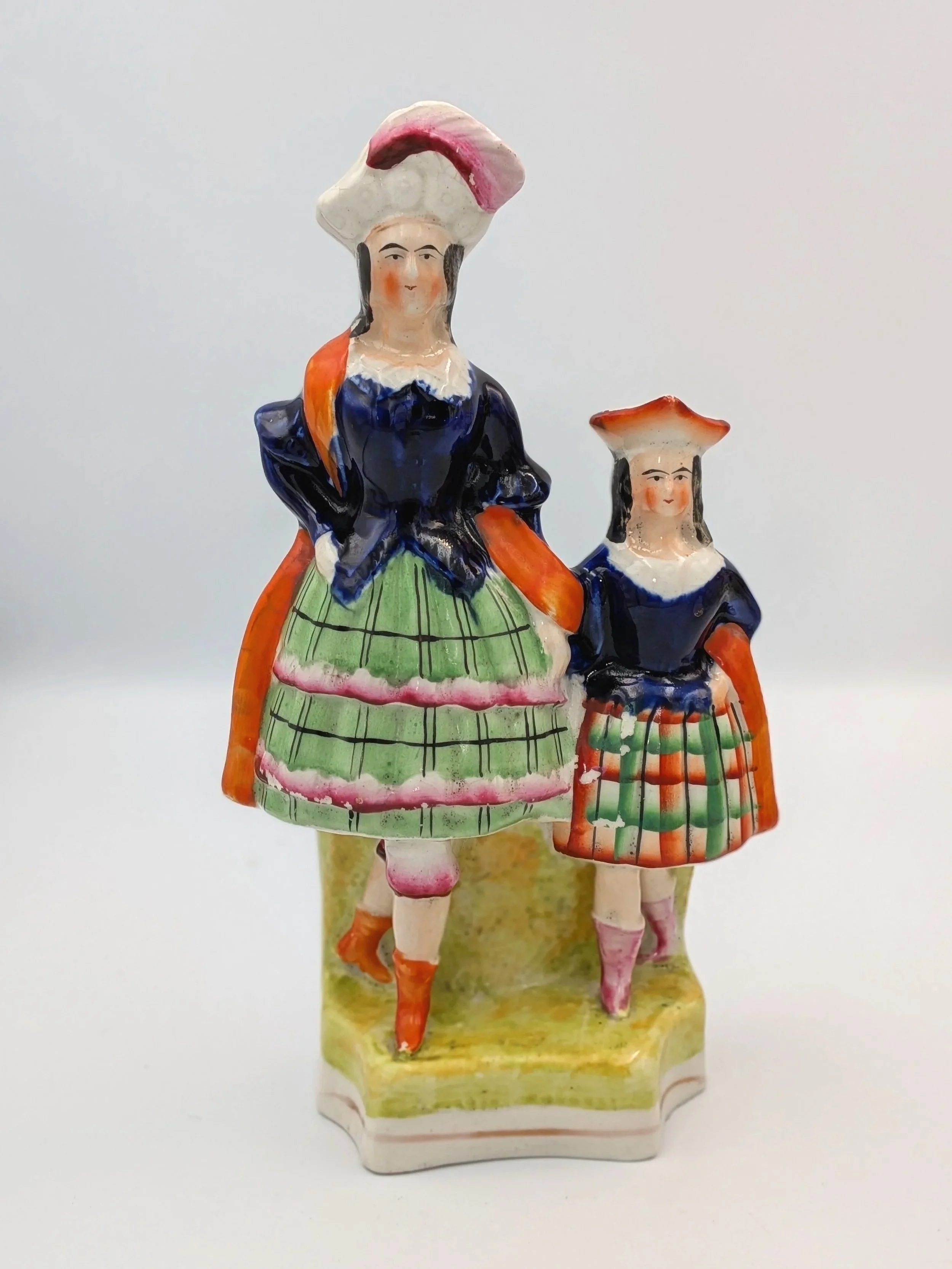
A charming and good quality figure depicting a woman and girl in the midst of some kind of performance.
This figure is sometimes identified as Queen Victoria and the Princess Royal (it pairs with a gentleman and boy which in turn is identified as Prince Albert and the Prince of Wales) but this is very unlikely given the shortness of the lady’s skirt. The figure may be attributable to the ‘Green Factory’.
This lovely figure is beautifully decorated with very nice patterns to the clothing and an appealing green base.
It is offered in excellent condition with only some enamel flaking.
Reference: A. & N. Harding, Victorian Staffordshire Figures 1835 - 1875: Book One, p. 392, fig. 1537
Height: 9”
Date: c. 1850
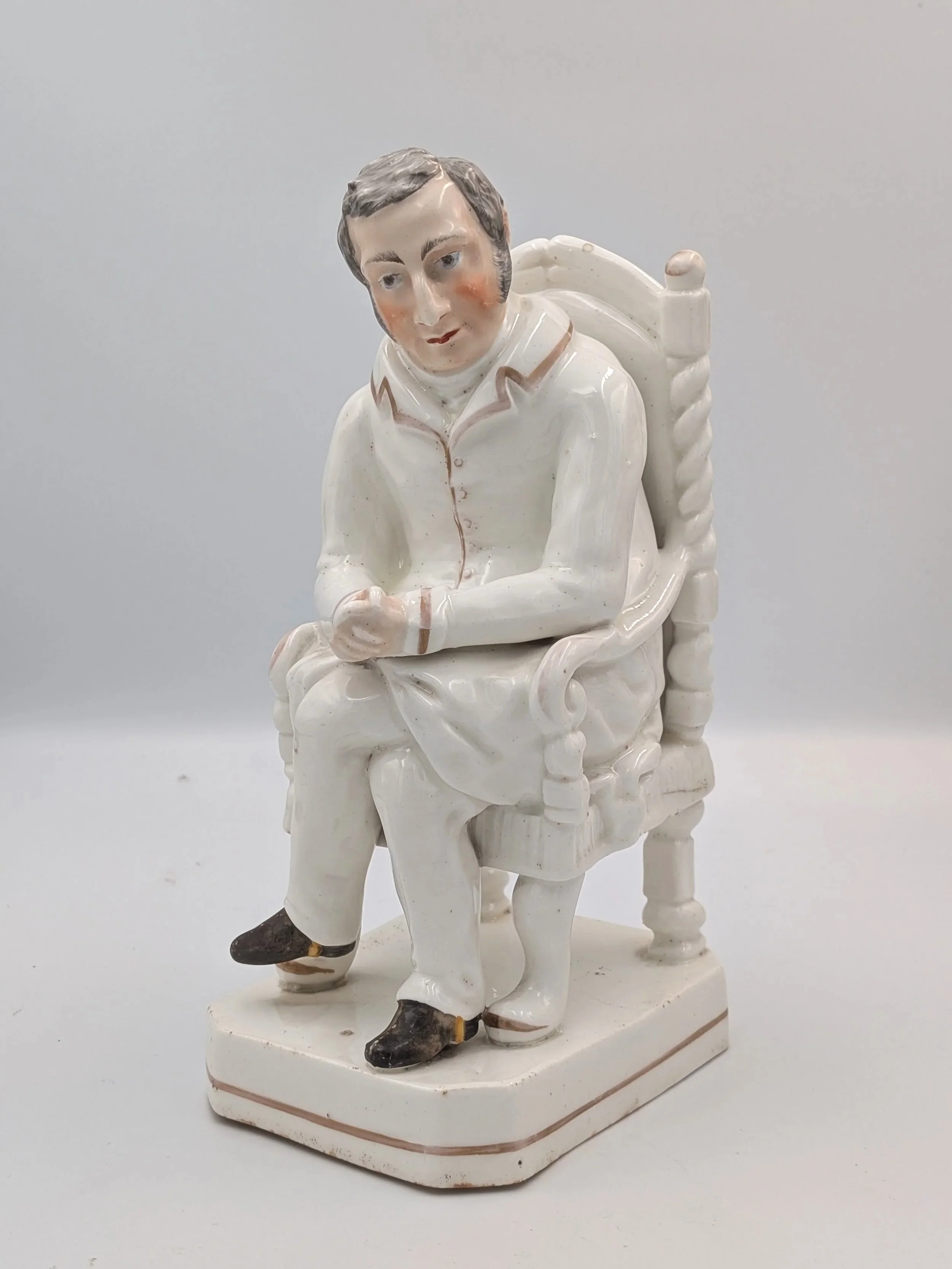
A very rare and good quality figure depicting Arthur Wellesley, Duke of Wellington, sitting in an ornate chair.
The figure is modelled after a lithograph music-front by Louisa Corbaux for the song Wellington by Charles Jefferys, published only two days after Wellington's death in 1852. It is one of a number of sought-after figures depicting the seated Wellington - he famously died in his armchair and it is believed these figures were made as a commemoration after his death.
The figure is decorated in white and gilt but the decoration of the face is exceptionally good.
It is in excellent condition with some light fading to the gilt and some staining in places.
Reference: P. D. Gordon Pugh, Staffordshire Portrait Figures, p. B216, pl. 5, fig. 29
Height: 8”
Date: c. 1852
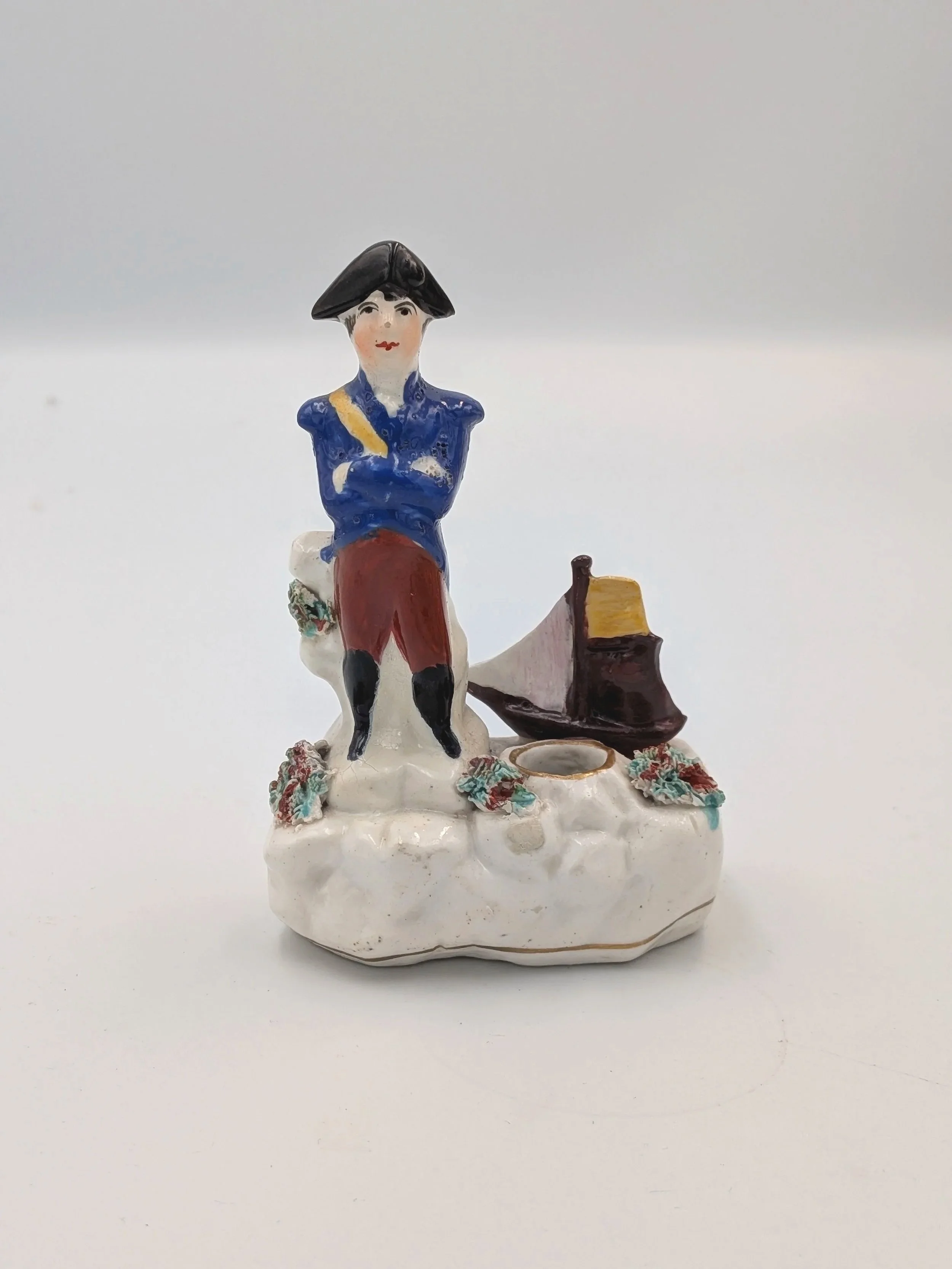
A rare and unusual pen holder depicting Napoleon Bonaparte standing with folded arms and a distant ship (possibly intended to represent Napoleon’s ship Orient which had a pivotal role at the Battle of the Nile in 1798; or the HMS Bellerophon aboard which he surrendered after Waterloo in 1815).
Pen holders featuring Napoleon are not unusual (at the time of listing, three other examples are available on this site) but this is an unusual and rarely seen version. The ship itself is independently modelled and the number ‘41’ is impressed to the back of the column supporting Napoleon and the underside of the rocky base.
This very appealing little figure is in good condition with some superficial wear and some imprecision in the glazing.
Reference: Possibly unrecorded
Height: 4”
Date: c. 1850
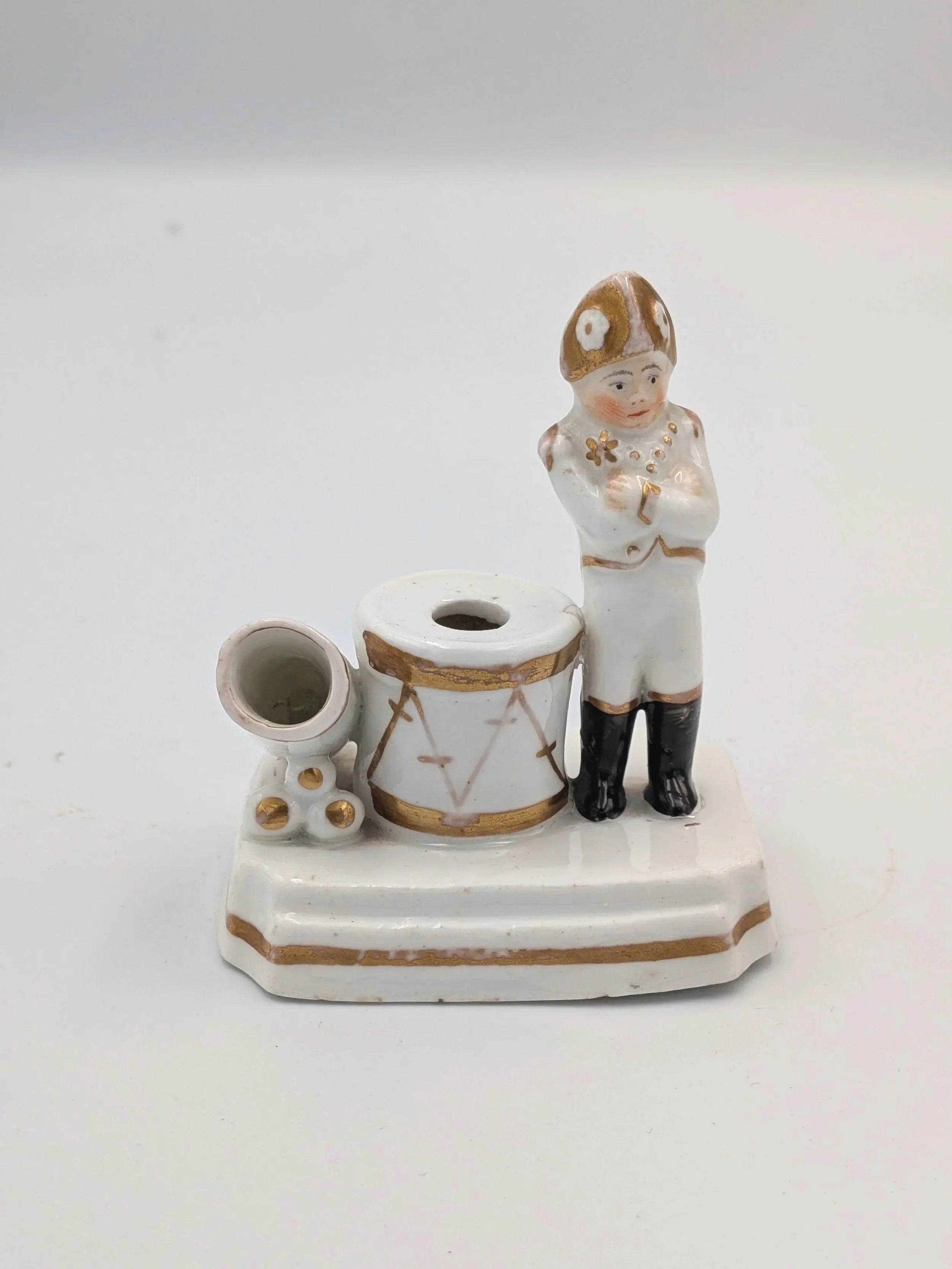
A very rare and fine porcelain pen holder and inkstand modelled as Napoleon Bonaparte standing with folded arms next to a drum (serving as an inkwell) and a cannon with cannonballs (serving as a pen holder).
This fabulous little figure is elegantly decorated in white and gilt. The modelling and composition are very impressive and it makes for a fantastic, scarce addition to any collection of Staffordshire Napoleons.
This figure displays excellently and is in good condition. There is a small stress hairline at the edge of the drum connected to Napoleon. There is some light fading of the gilt and old, tiny nibbles to the base.
Reference: Possibly unrecorded
Height: 3.25”
Date: c. 1840
Provenance: former stock of Miles Antiques (original price label left in place)
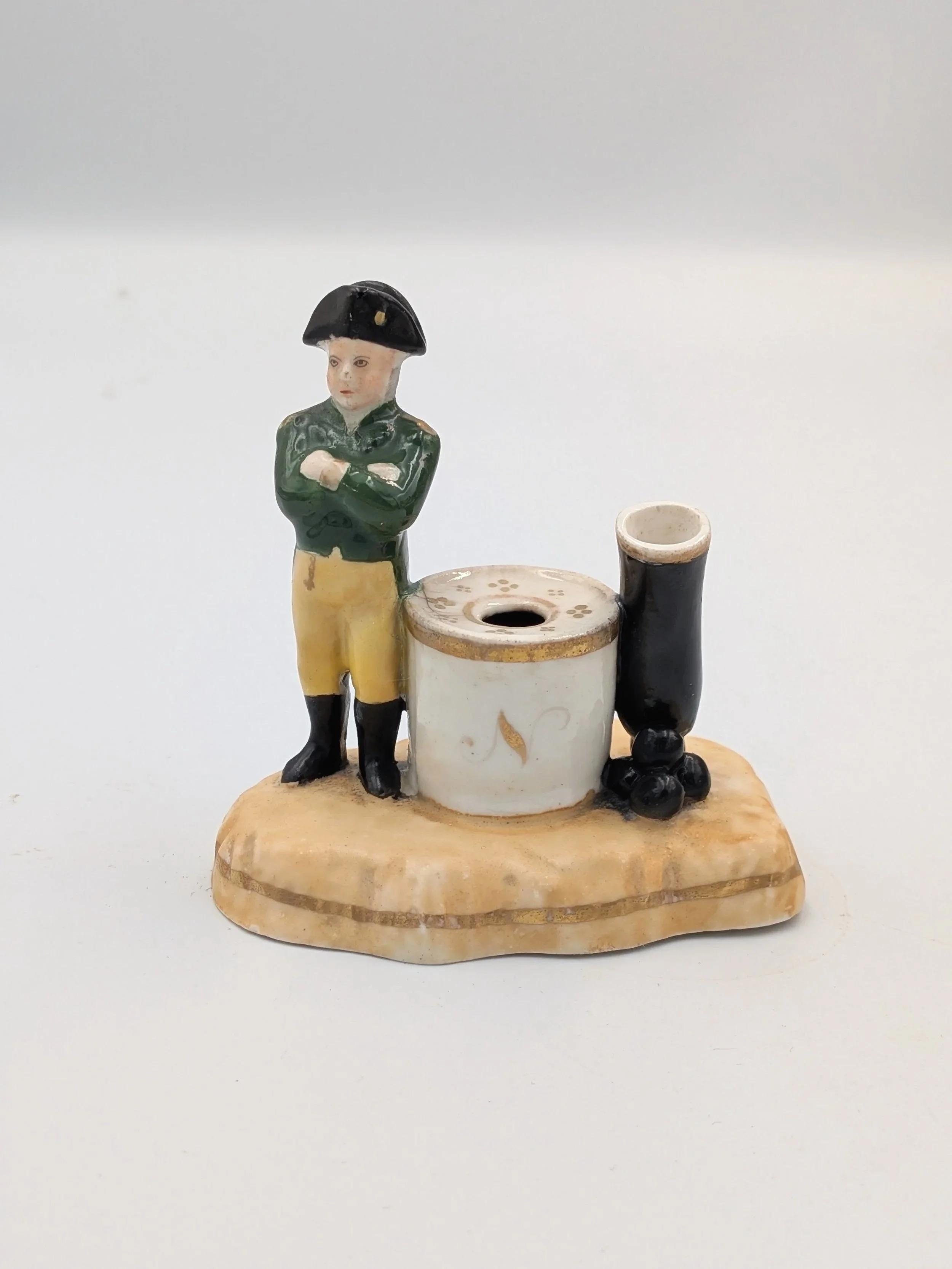
A rare diminutive porcelain pen holder and inkwell modelled as Napoleon Bonaparte standing with folded arms next to a white drum, cannon, and cannon balls on a yellow base with gilt band.
Napoleon wears a green jacket with yellow breeches, black boots, and a black cocked hat. The drum-like inkwell is decorated with a gilded capital letter ‘N’ and a gilded pattern around the aperture. The cannon and balls are black and serve as a pen holder.
This unusual and beautifully made little piece displays very well but has some imperfections. Napoleon has been professionally reattached and there is a small hairline web to the top of the drum. There is some loss to the gilt.
Reference: Possibly unrecorded
Height: 3”
Date: c. 1840
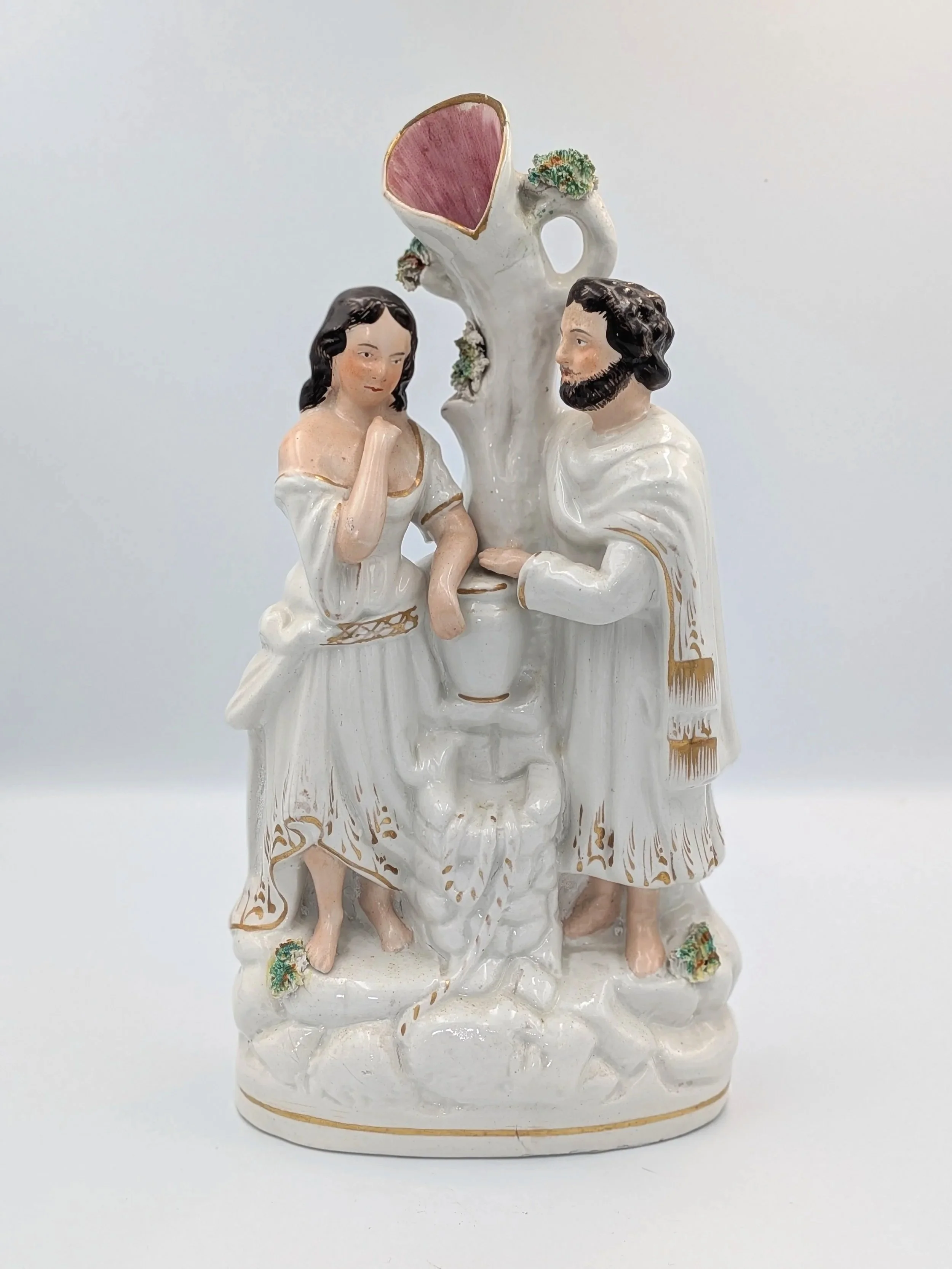
A beautiful and superb spill vase depicting Jesus Christ and the woman of Samaria at the well, as described in John 4.
'But whosoever drinketh of the water that I shall give him shall never thirst; but the water that I shall give him shall be in him a well of water springing up into everlasting life.' (John 4:14)
The story of Christ and the Samaritan woman was one of the most widely depicted biblical stories by the Staffordshire potters with several recorded groups and pairs, some of which can be seen in the SOLD section of this website.
This stunning figure is exceptionally well made with fabulous details and independent modelling. The decoration, though sparse, is very effective with wonderful gilding and good faces. Some features of this figure suggest it may have been made by the Parr Factory but I could not guarantee this.
The figure is in excellent condition. There is a firing flaw to the rim of the base and a rubbed portion of the gilt at the mouth of the spill has been repainted.
Reference: A. & N. Harding, Victorian Staffordshire Figures 1835 - 1875: Book Two, p. 23, fig. 1703
Height: 11.75”
Date: c. 1865
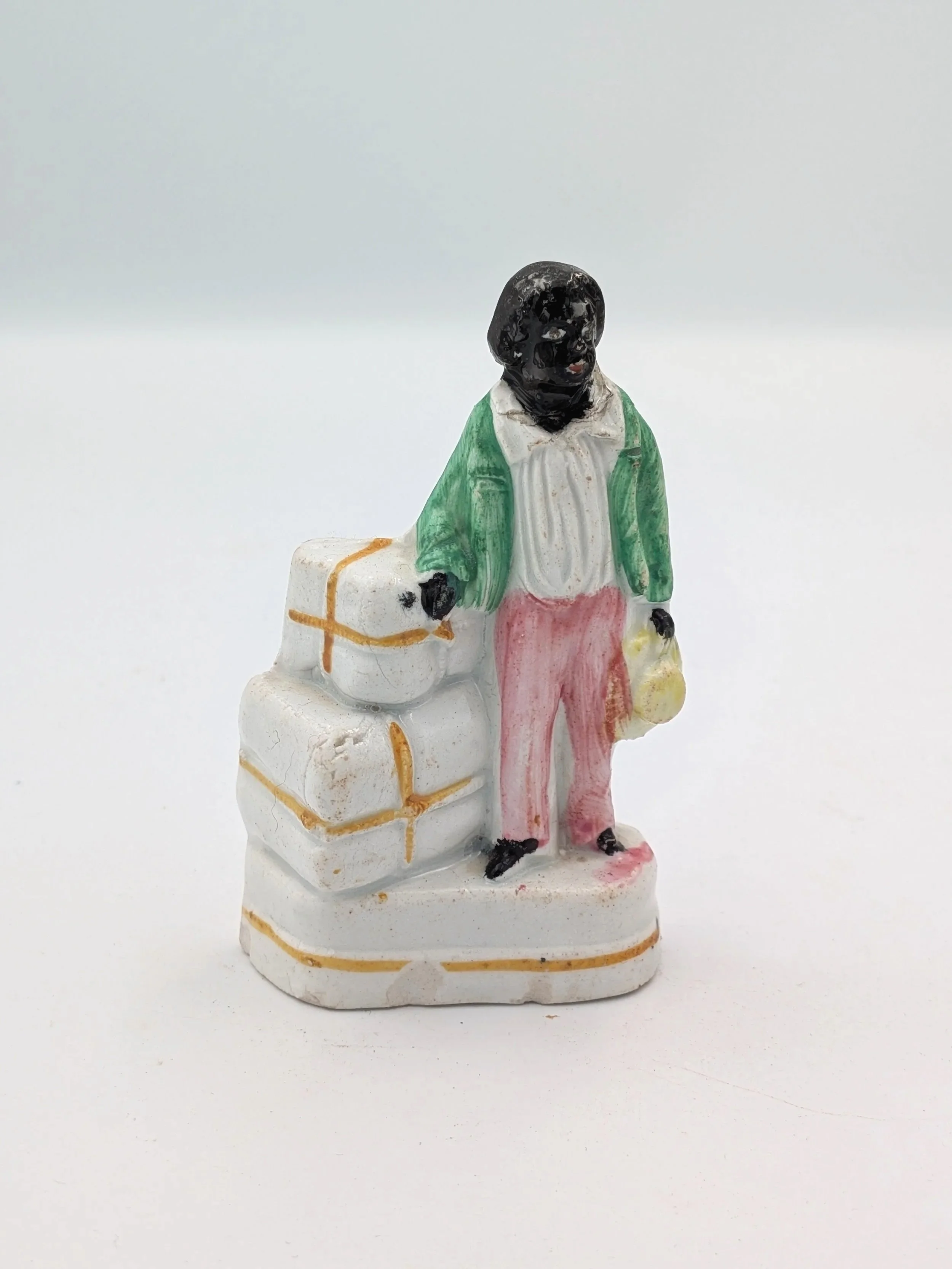
A lovely miniature depicting Uncle Tom - the titular character from the abolitionist novel Uncle Tom’s Cabin - standing by bails of cotton.
This little figure pairs with a similar figure of Eva (not offered here).
The figure presents well but it should be noted that the figure has been repaired at the neck and there are two shallow chips to the rim of the base.
Height: 3.5”
Date: c. 1852
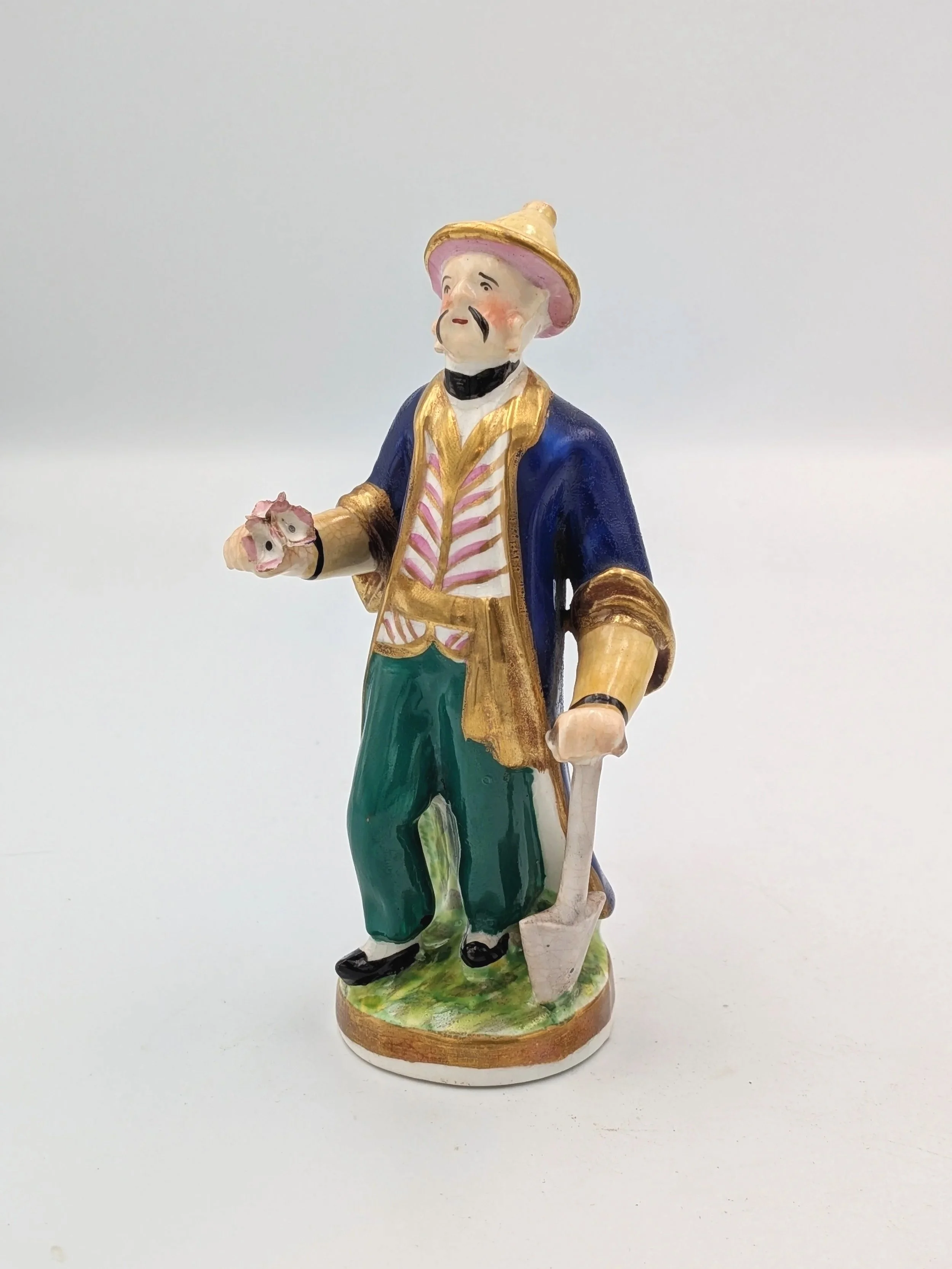
A very rare and exquisite porcelain figure depicting a gardener (described as a ‘Chinese gardener’ in historic Dudson ledgers) with a spade and bunch of flowers, made by the Dudson Factory.
This superb figure is exceptionally well decorated with vivid, saturated colours and striking gilt. The gardener holds a bunch of flowers made up of individually moulded, very fragile petals which can be found in other Dudson figures of this period.
This fabulous and impressive figure is in excellent repaired condition with professional, practically invisible repair to both elbows and tiny edges of loss to the petals. There is some failure of the glaze to the cobalt cloak, giving a pockmarked texture.
Reference: Apparently unrecorded, but similar to examples found in: A. Dudson & A. Morgan, Dudson Staffordshire Figures c. 1815 - c. 1865, p. 40
Height: 4.75”
Date: c. 1830s
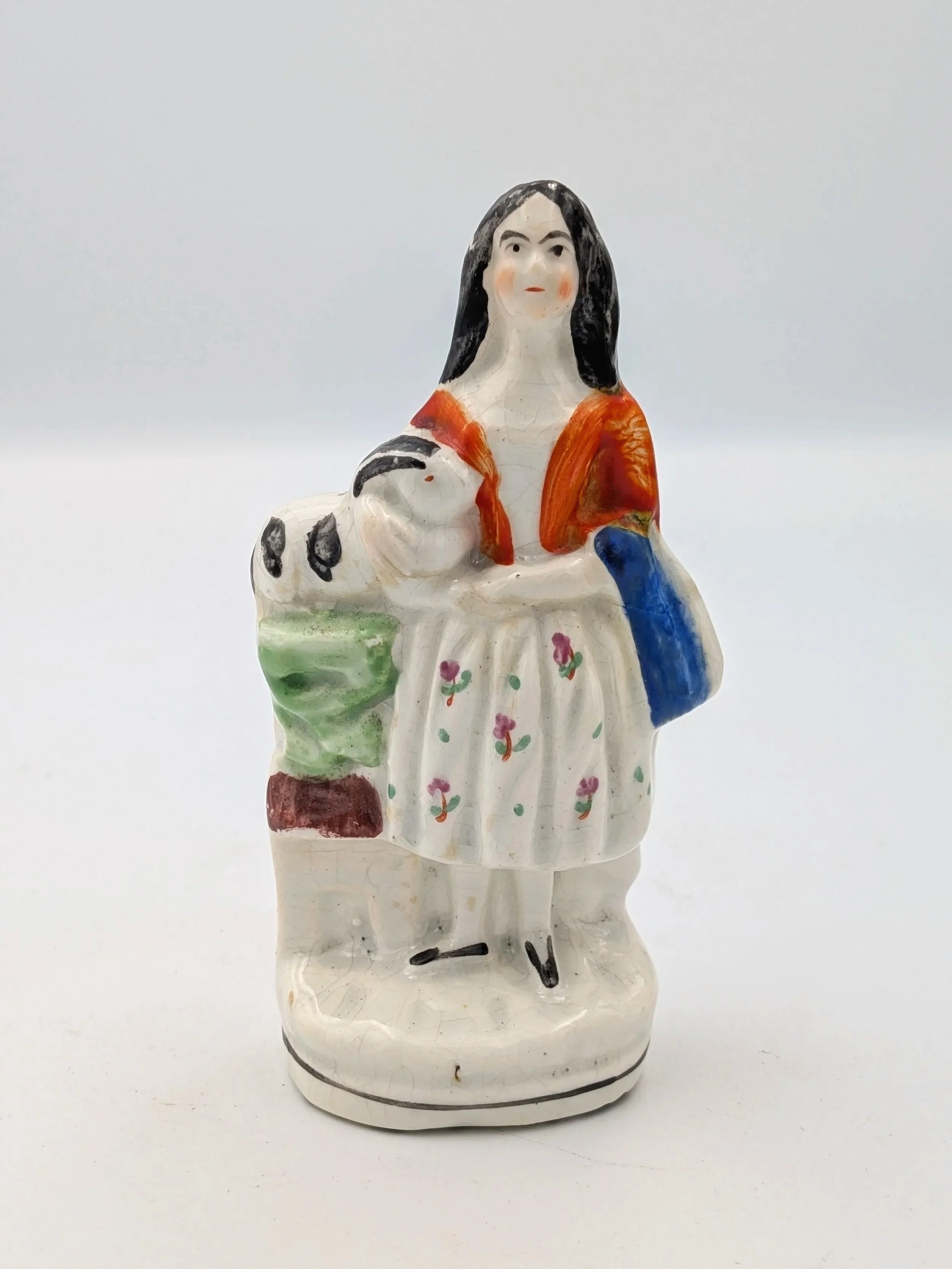
A delightful and good quality miniature figure depicting a girl with a pet rabbit.
The girl, wearing a floral patterned skirt, has her arm around her rabbit which is sitting atop a hutch or table.
The figure is very nicely modelled for the size - well decorated, crisp, and with a lovely glaze.
The figure is in excellent original condition with some crazing and some flakes to the girl’s black hair.
Reference: Possibly unrecorded
Height: 4.5”
Date: c. 1860
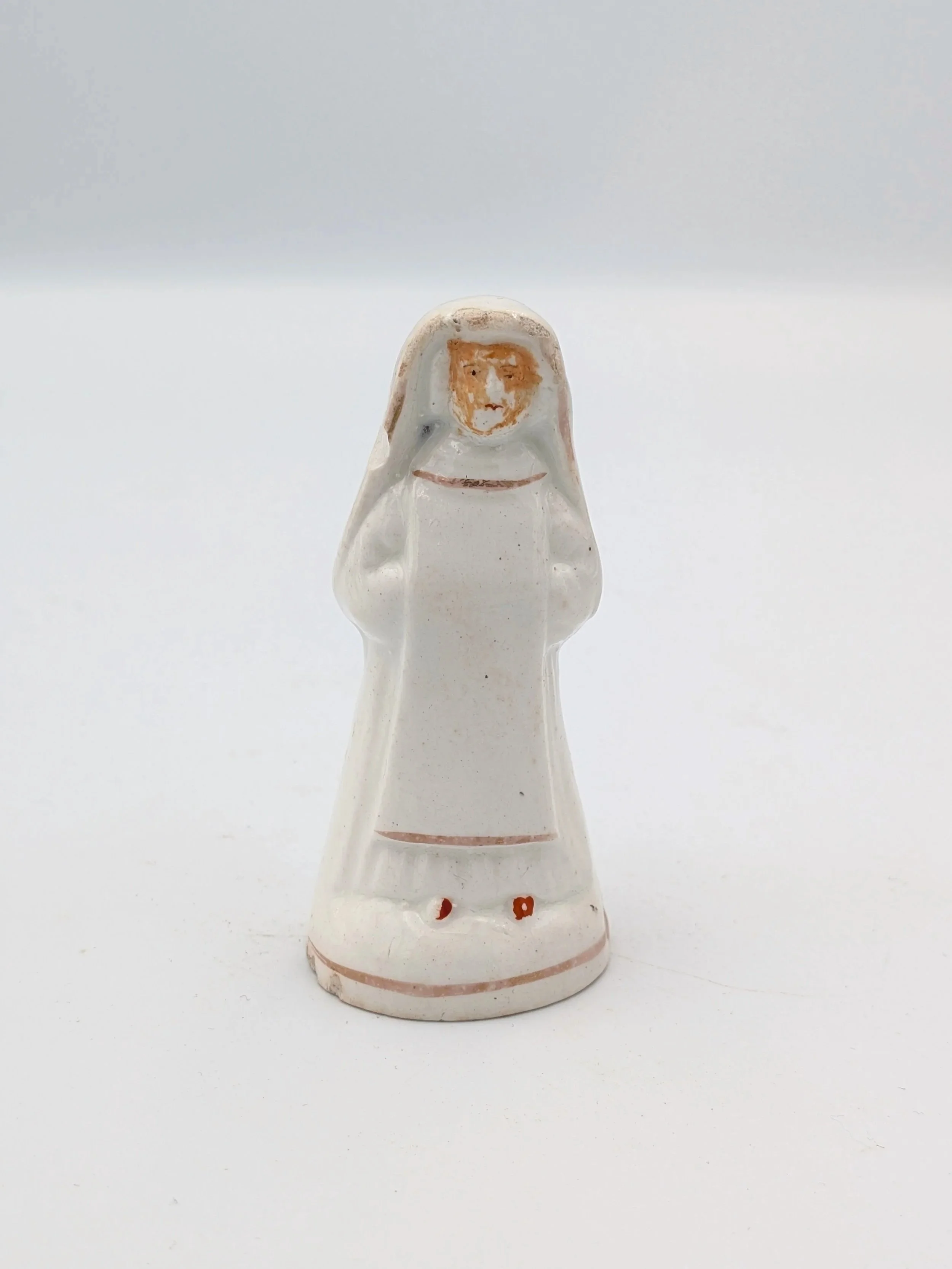
An unusual diminutive figure depicting a nun in full white habit, possibly intended as a candle snuffer.
The subject of the figure may be the Dominican advocate for child labour reform and education, Mother Margaret Hallahan.
There is a small chip to the wimple and some old nibbles to the base, as well as some flaking to the face.
Reference: Possibly unrecorded
Height: 3”
Date: c. 1840s
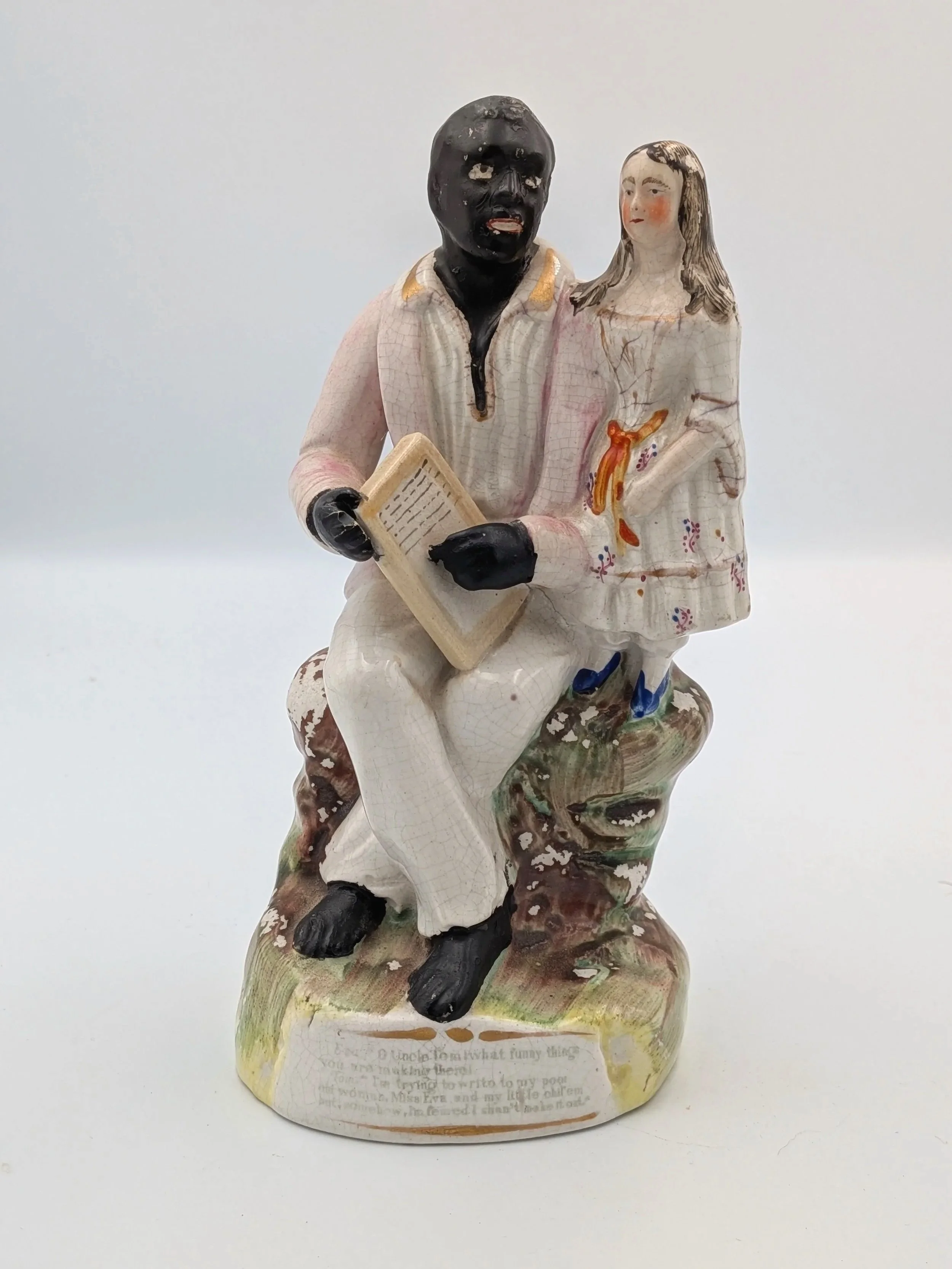
An impressively detailed and well composed figure depicting Uncle Tom and Eva from the abolitionist novel Uncle Tom’s Cabin. This figure was produced by the Thomas Parr Factory.
Eva stands next to a seated Tom while he writes on a page. They are modelled atop a naturalistic base. A large gilt bordered title reads:
Eva to Uncle Tom, what funny things you are making there! Tom: "I'm trying to write to my poor old woman, Miss Eva and my little children but, somehow I'm feared I shan't make it out"‘
The figure is in reasonably good restored condition and displays well. Tom’s right hand’s fingers have been professionally restored. There is fairly extensive flaking to Eva’s hair and the base, and the title is faded. It is likely that Tom’s skin has been partially or entirely overpainted.
Reference: A. & N. Harding, Victorian Staffordshire Figures 1835 - 1875: Book One, p. 299, fig. 1088
Height: 7.5”
Date: c. 1852
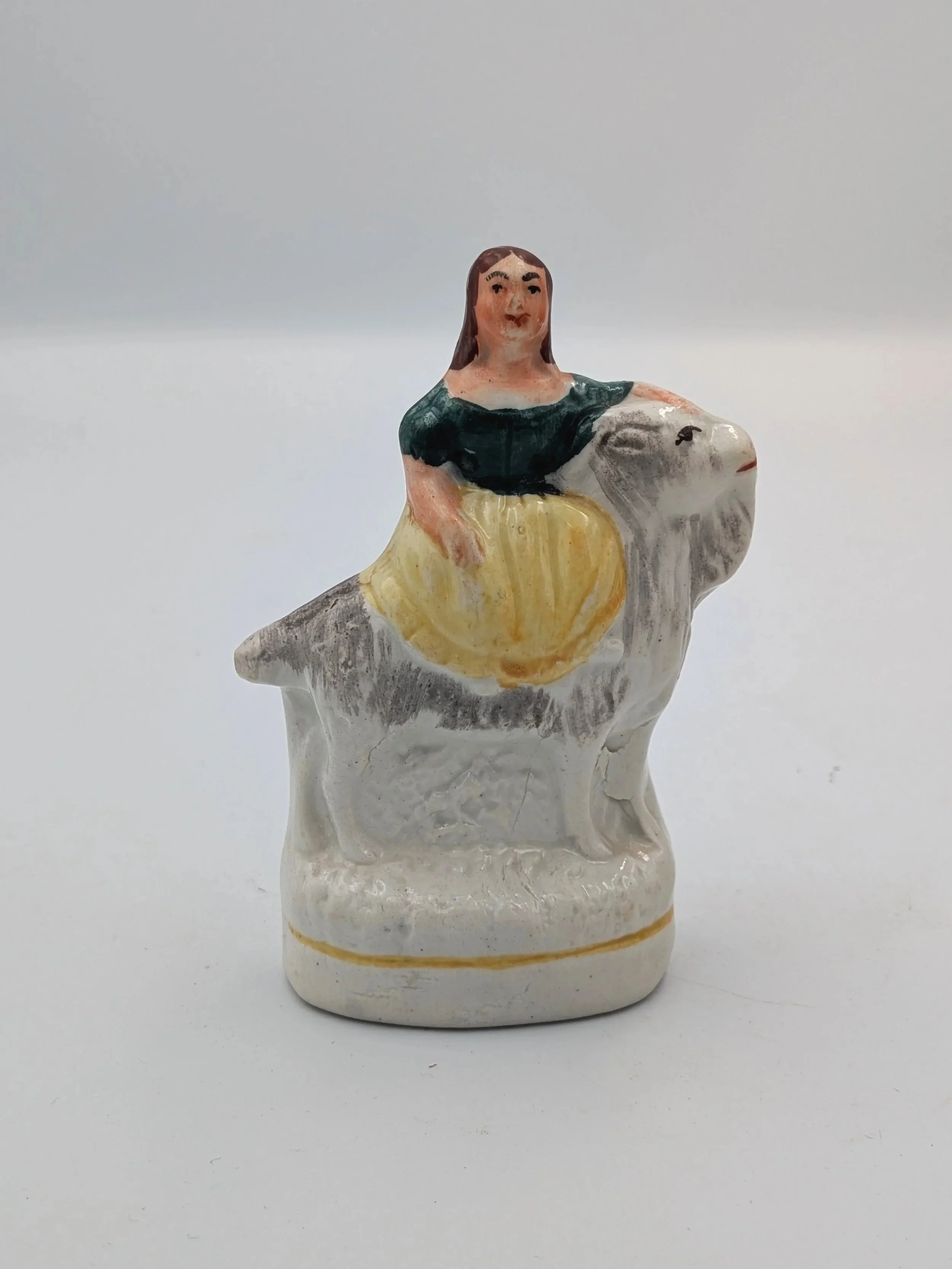
A very sweet little figure depicting a girl riding a grey goat.
She wears a green blouse and yellow skirt and sits side-saddle on a light grey goat atop a white naturalistic base with yellow band.
This simple little figure is in excellent original condition - naively decorated and modelled but very legible and appealing.
Reference: Possibly unrecorded
Height: 4”
Date: c. 1850s
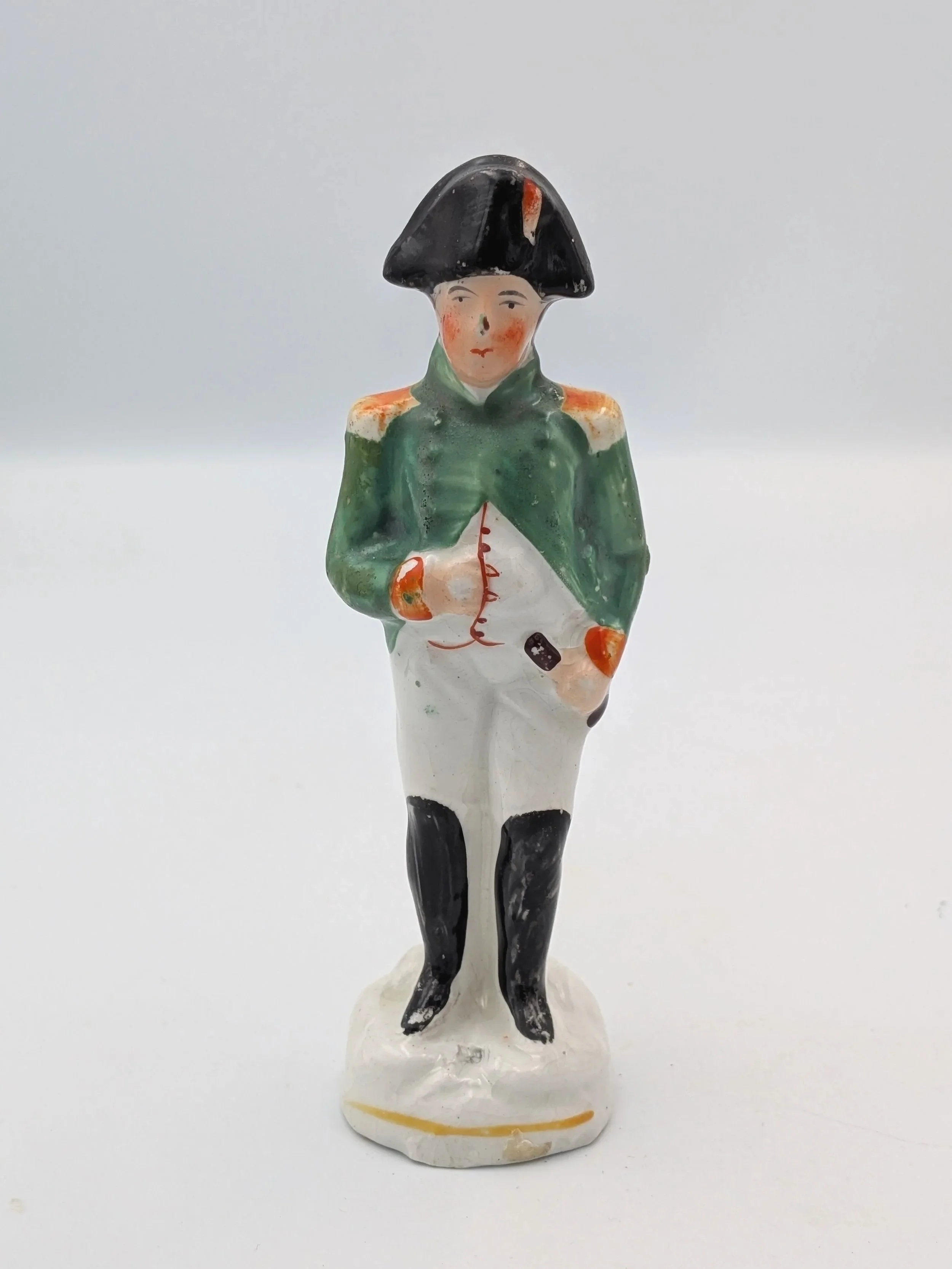
A pleasing little figure depicting Napoleon Bonaparte, standing in military garb and a cocked with his right hand inside his jacket and a baton or spyglass in his left hand.
This simple but nicely modelled little figure is in very good original condition. There is a spot of stray enamel on the tip of Napoleon’s nose (this is not damage or rubbing), some very small spots of flaking to some of the enamels, and a spot of retouching to the black hat.
Reference: Possibly unrecorded
Height: 5.25”
Date: c. 1850s
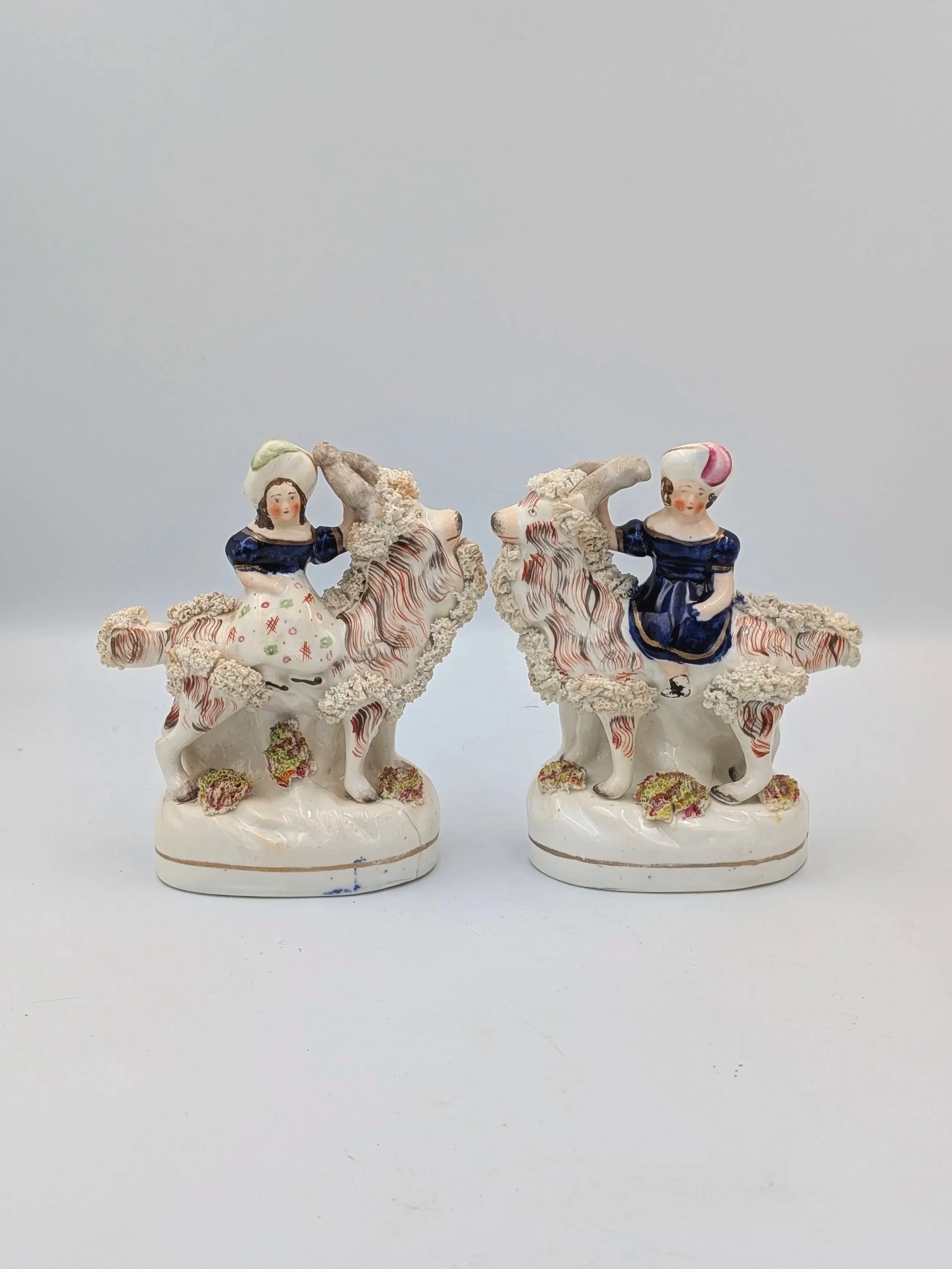
A charming and well decorated pair of figures depicting two children - generally thought to be the Princess Royal and Prince of Wales - riding on goats.
These figures fall into the category of speculative royal identification. The Hardings note that at least five versions of these figures were produced, even years after the royal children were children. This particular pair appears in style and form to date to the correct period to judge them as contemporary, though an inevitable question mark must qualify the identification of 'royal'.
Both figures are in very good condition. Some of the shredded clay hair on the tail of the Princess’ goat is missing and there is a superficial hairline to that figure’s base. There is some flaking to the Prince’s face.
Reference: A. & N. Harding, VIctorian Staffordshire Figures 1835 - 1875: Book One, p. 188, figs 598 and 599
Height: 5.75”
Date: c. 1845
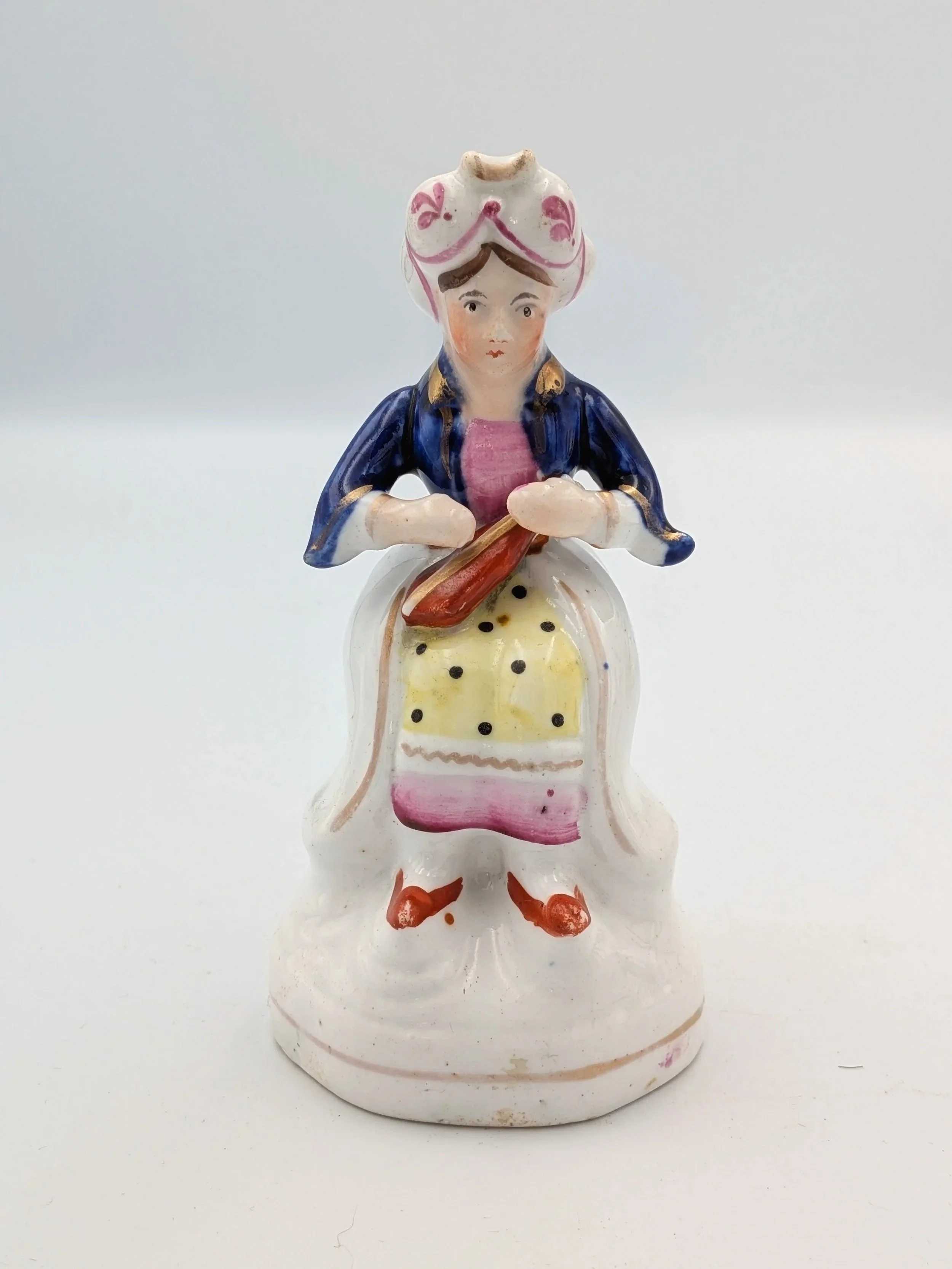
A fine and delicate porcelain figure depicting a seated female musician in eastern or Ottoman dress with a stringed instrument in her lap. It is believed that this figure - which pairs with a similar male figure - depicts the character Mandane from the Thomas Arne opera Artaxerxes.
Figures of Mandane and Artabanes (the male pair) were produced in several forms of which this seems to be unrecorded but bears such notable similarities to recorded version that it must be the same subject.
This example is of lovely quality with independent hands and musical instrument. It is strikingly decorated.
The figure is in good condition but for an old chip to the back of the hollow base (not visible when displayed), some fritting, and fading of the gilt.
Reference: Similar figure: A. & N. Harding, Victorian Staffordshire Figures 1835 - 1875: Book One, p. 337, fig. 1233
Height: 4.75”
Date: c. 1840
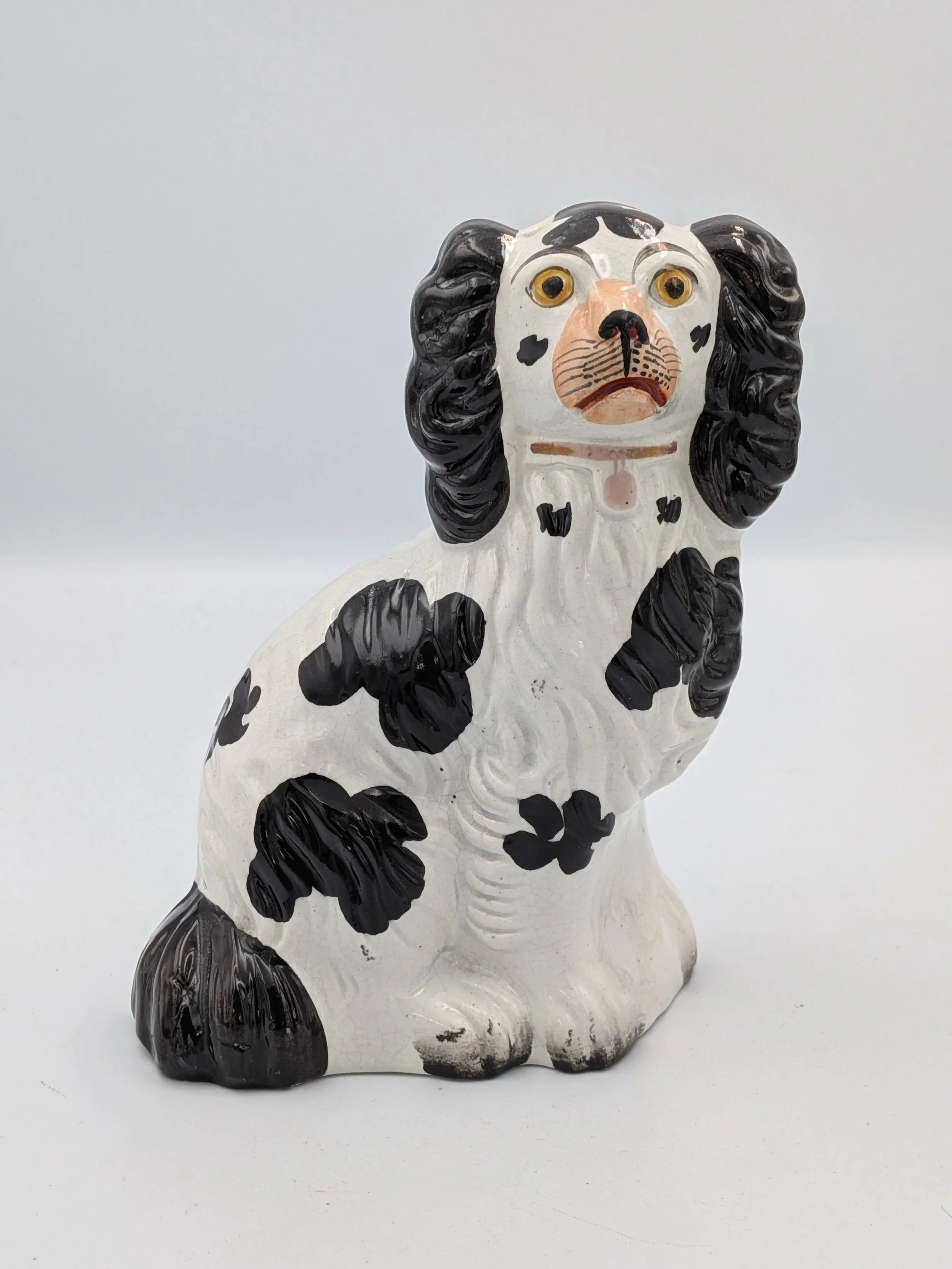
An excellent single black and white spaniel in the Number 5 size.
The right-facing spaniel is decorated with underglaze black spots, yellow eyes, and a gilt collar and padlock.
It benefits from good, crisp modelling and textures, as well as vivid and clear decoration.
The figure is in very good condition with a shallow nick to the tail having been overpainted.
Reference: A. & N. Harding, Victorian Staffordshire Dogs, p. 19, fig. 2424
Height: 6.5”
Date: c. 1850s
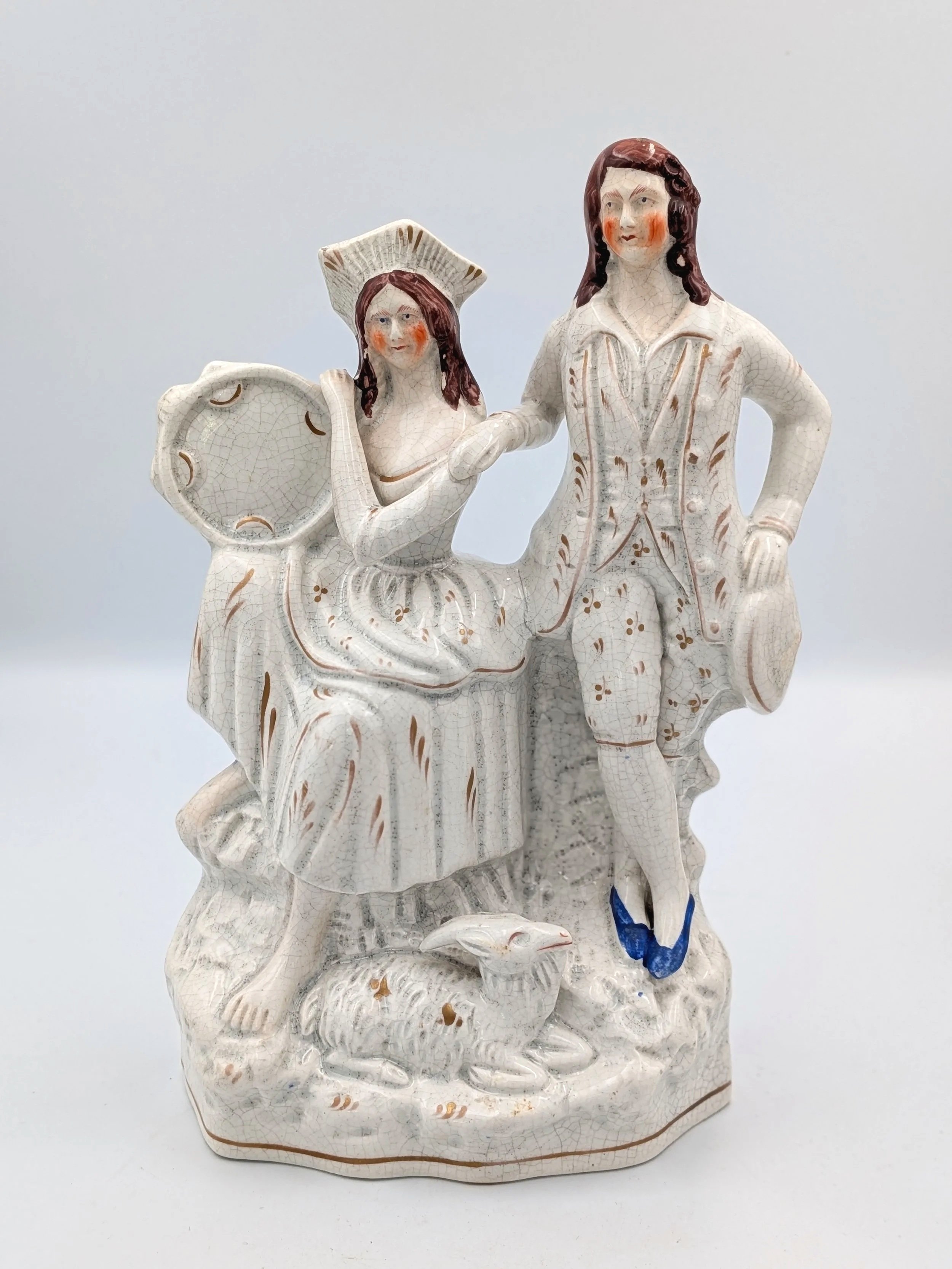
A very attractive and well made figure of substantial scale depicting a woman with a tambourine, and man leaning by her side, and a goat at their feet.
This striking figure is sparsely decorated but with excellent use of gilt, facial details, and independently modelled elements which demonstrate its real quality.
The figure has some hallmarks of Dudson Factory figures of this period - blue shoes, blue eyes, certain gilt motifs, and Dudson-esque faces - though this is not at all certain.
It is possible that the inspiration for this figure is Esmeralda and Gringoire - the principal characters from the Jules Perrot choreographed ballet La Esmeralda, based on Victor Hugo's novel Notre-Dame de Paris and premiering with Perrot and his wife Carlotta Grisi. Such figures (of which several forms were made) typically include the elements: a woman with a tambourine, a man with a triangle, and a goat. However, the characters in this figure are not dancing and the man does not have a triangle. Furthermore, the ballet premiered in 1844 and most related figures date to that period. This figure seems to be too late.
Either way, this is a fabulous figure group - very striking and employing to great effect the white-and-gilt style of this period.
In excellent condition with no damage, but with visible crazing, some flaking, and some spots where the glaze has landed too thickly and picked up kiln debris.
Reference: Possibly unrecorded
Height: 10.5”
Date: c. 1860s
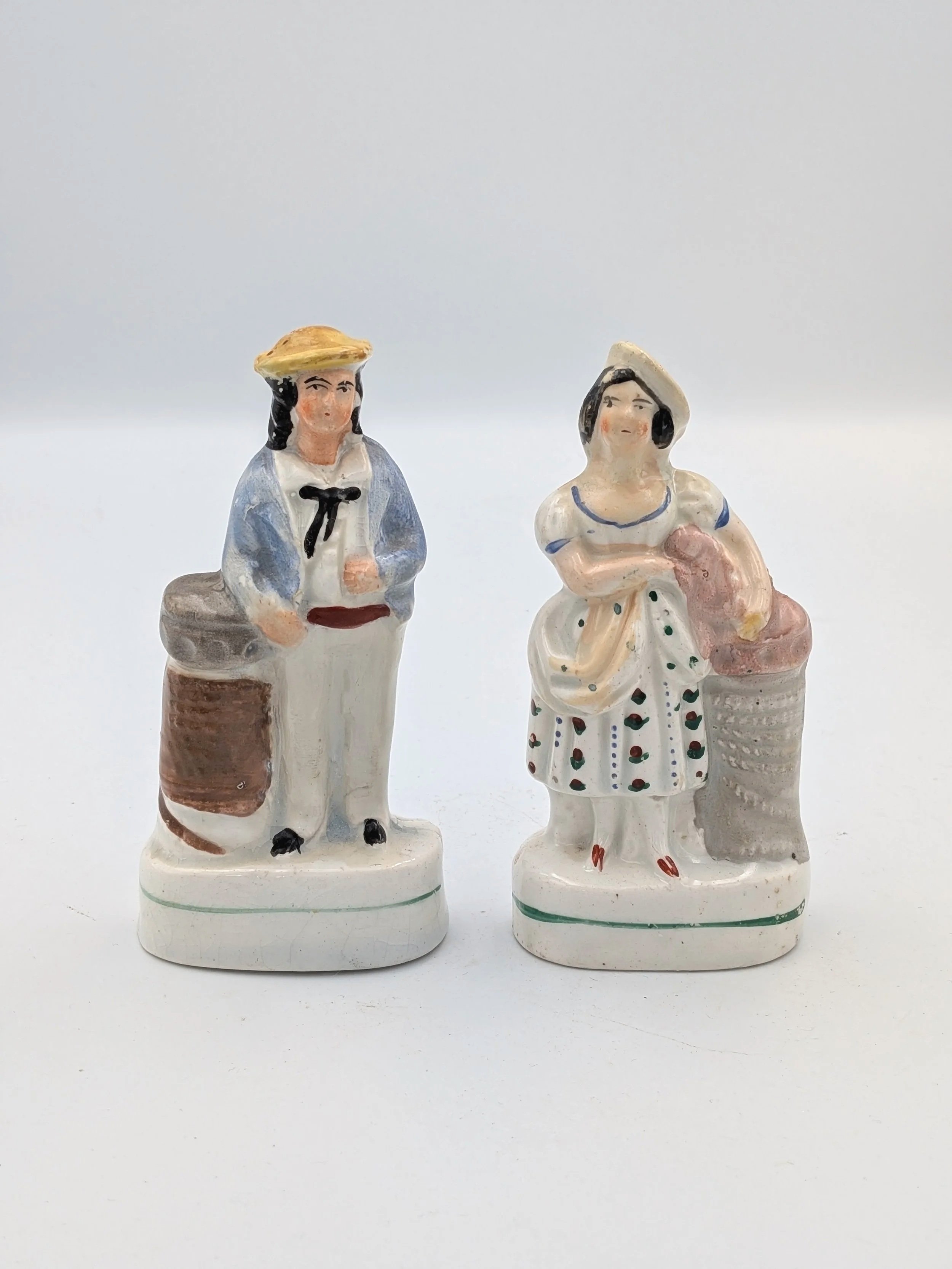
A charming pair of small figures depicting a sailor and girl standing next to roped bollards.
The sailor figure was produced in four sizes, but the companion figure was made only in the smaller two sizes.
These little figures are naïve but are offered in good condition, presenting well. There is an old, shallow chip to the back of the female figure and some light discolouration and flaking.
Reference: A. & N. Harding, Victorian Staffordshire Figures 1835 - 1875: Book One, p. 245, figs 871 and 872
Height: 4.25”
Date: c. 1854
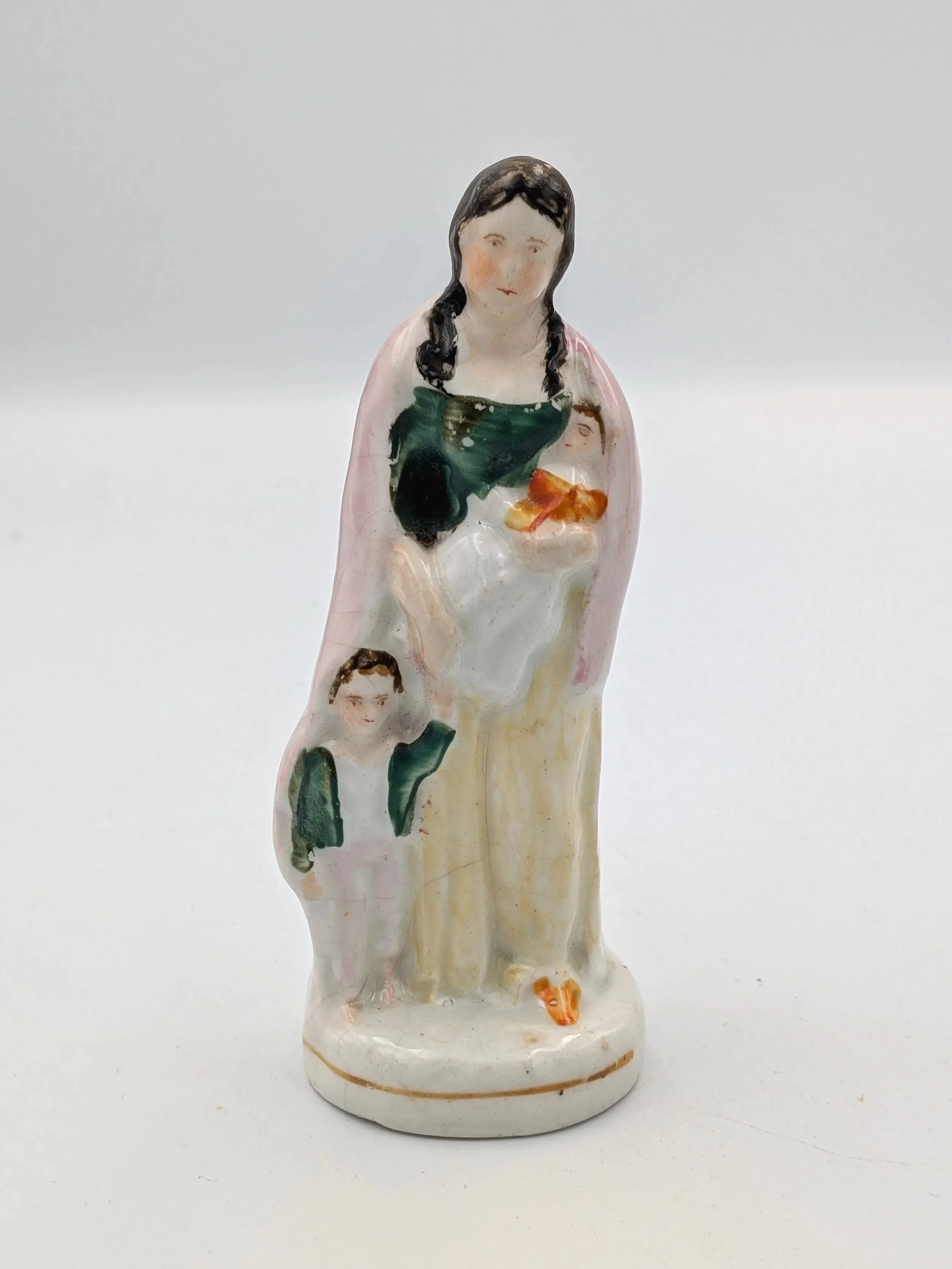
A scarce and unusual Victorian figure depicting the personification of Charity in the form of a woman holding the hand of a child and with a baby in her arms.
This small figure is a later copy of a very common pre-Victorian figure form (perhaps the most commonly produced early Staffordshire forms). This later version follows the type of Victorian figures, which is to say it is made from a single, simple mould with any independent elements, unlike the earlier predecessors.
A pattern of four ochre dots int he form of a diamond is painted on the base.
This figure is in nice original condition with no damage or repair. There is some flaking to the green elements and hair, as well as some fading and discolouration.
Reference: Possibly unrecorded
Height: 4.5”
Date: c. 1840s
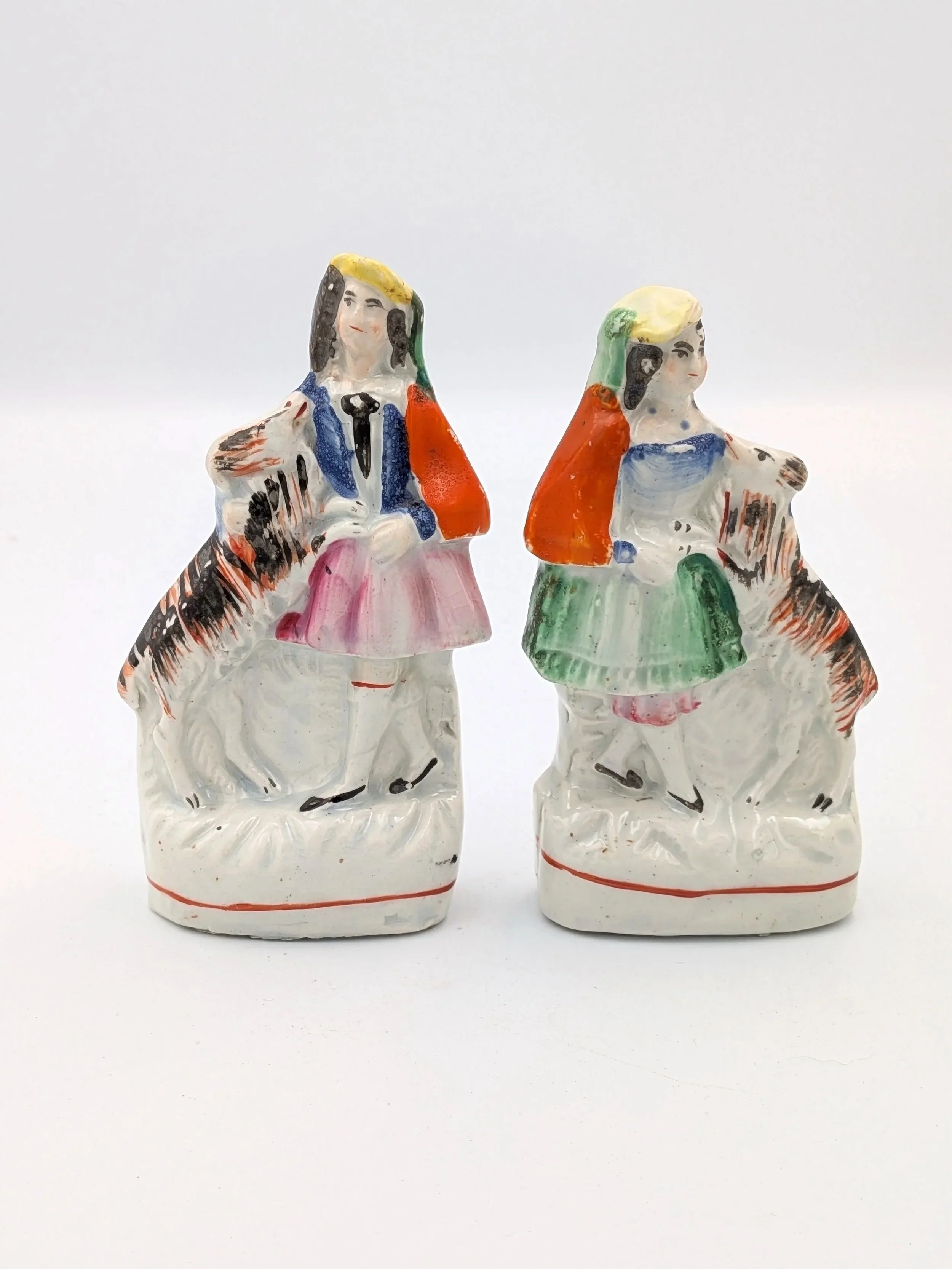
A lovely pair of diminutive figures depicting children standing with goats.
The well-dressed boy and girl stand cross-legged holding the front lefts of their affectionate pet goats.
These simple, naïve figures are in good condition with some flaking, firing flaws, and enamel misapplication.
Reference: Possibly unrecorded
Height: 4.75”
Date: c. 1860
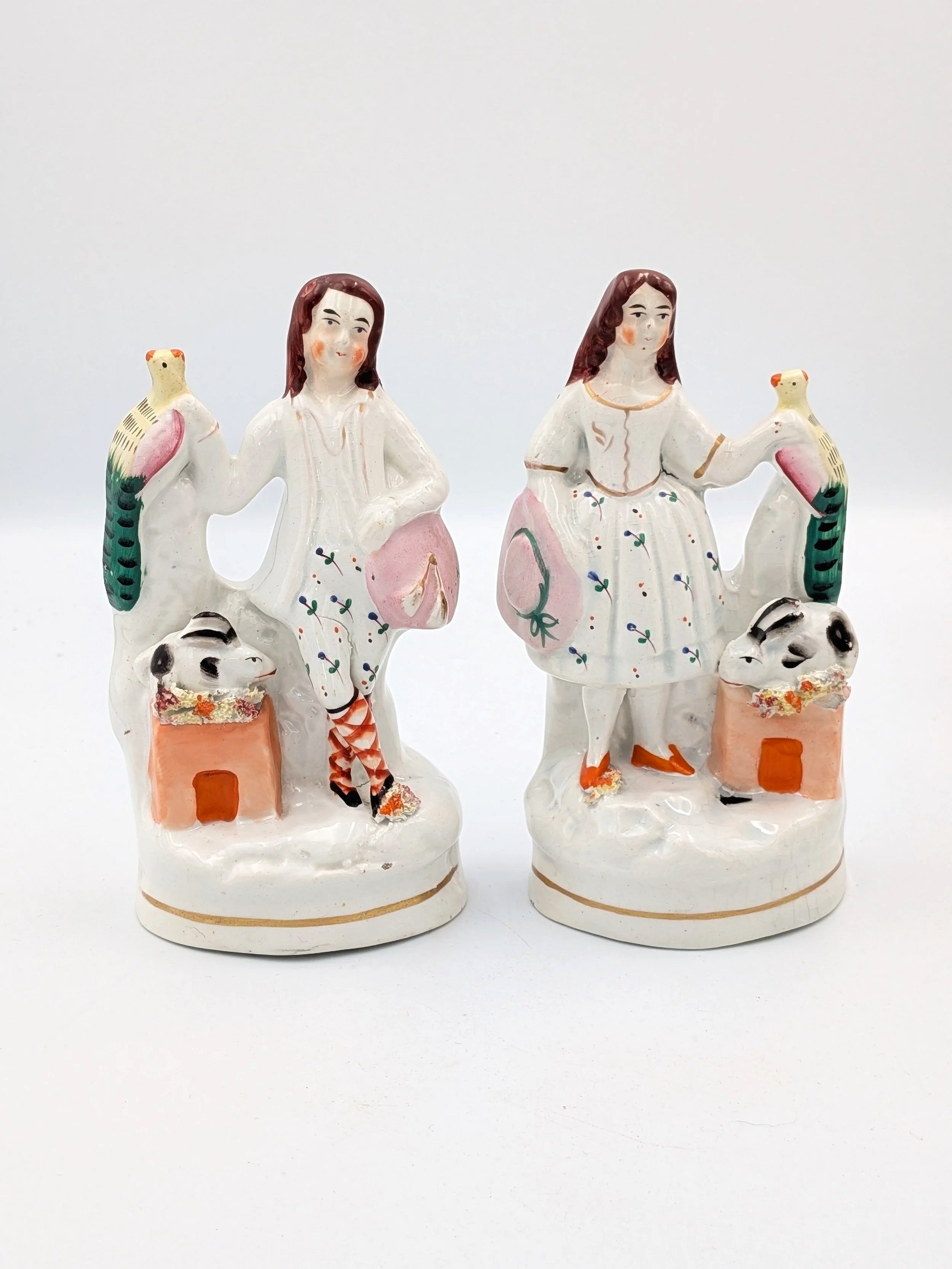
A very sweet and endearing pair of figures depicting a boy and girl standing with colourful birds and pet rabbits sitting atop their hutches.
The nicely modelled figures are simply decorated with sparse colouring, but independently modelled elements (the children’s legs, the rabbits, etc.).
These appealing figures are in excellent condition with no damage or repair, only some negligible firing flaws to the male figure.
Reference: A. & N. Harding, Victorian Staffordshire Figures 1835 - 1875: Book Two, p. 169, figs 2389 and 2390
Height: 6”
Date: c. 1860s
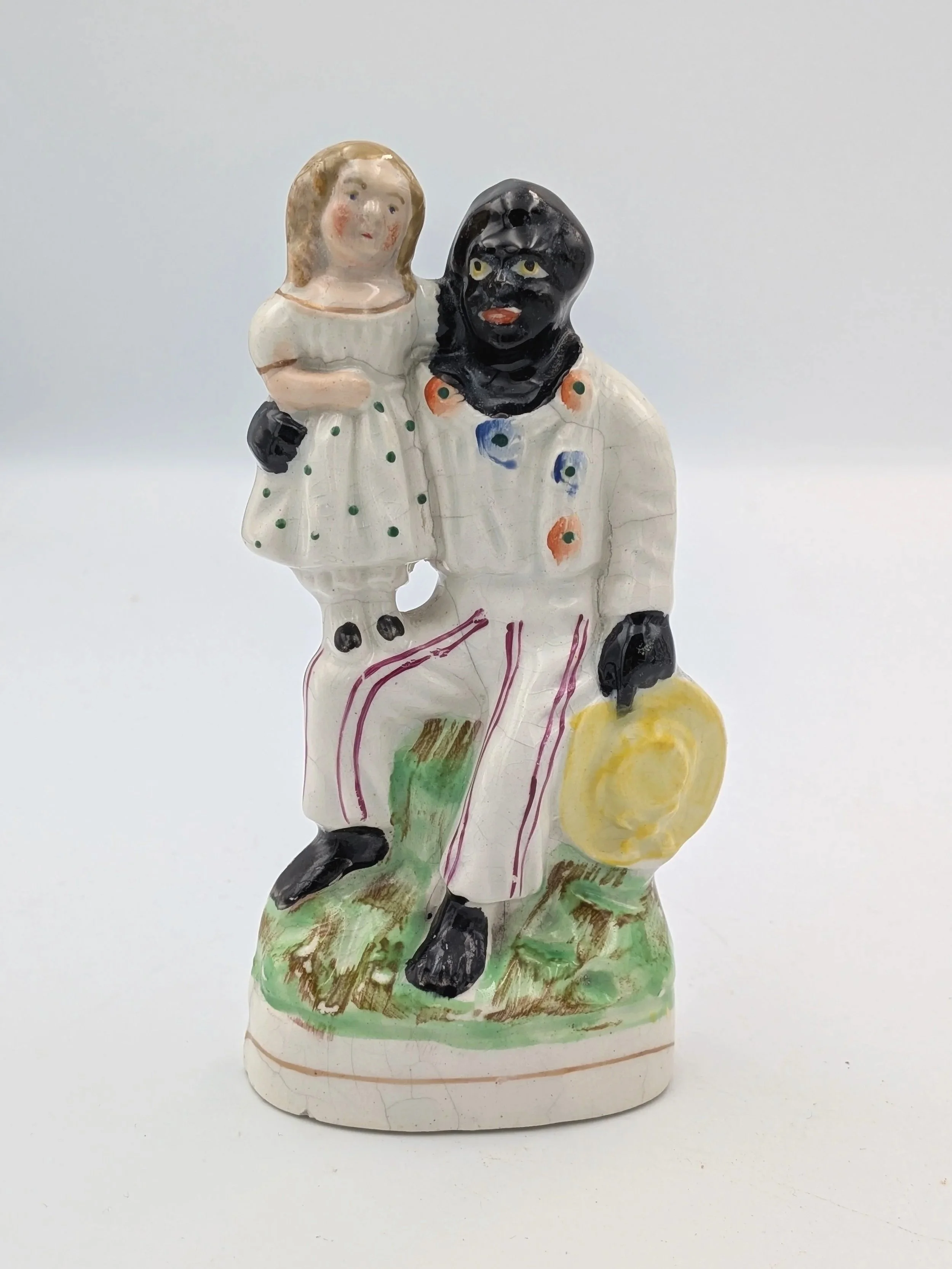
A nicely made small figure depicting Uncle Tom and Eva from the abolitionist novel Uncle Tom’s Cabin.
As with similar Staffordshire depictions of these characters, Uncle Tom is seated and little Eva stands on his leg, his arm around her.
Uncle Tom’s Cabin was a very popular subject for the Staffordshire potters who had deep abolitionist sympathies. Although the depiction of Tom in most such figures is heavily inspired by music hall acts, the sentiments of the potters towards this character were warm.
The figure presents well and is in good condition. There are some deep crazing / firing lines (which are not damage) across the front and back of the figure and a negligible little nick to the base.
Reference: Possibly unrecorded, but a larger, more elaborate titled version can be found in: A. & N. Harding, Victorian Staffordshire Figures 1835 - 1875: Book One, p. 300, fig. 1090
Height: 5.25”
Date: c. 1860
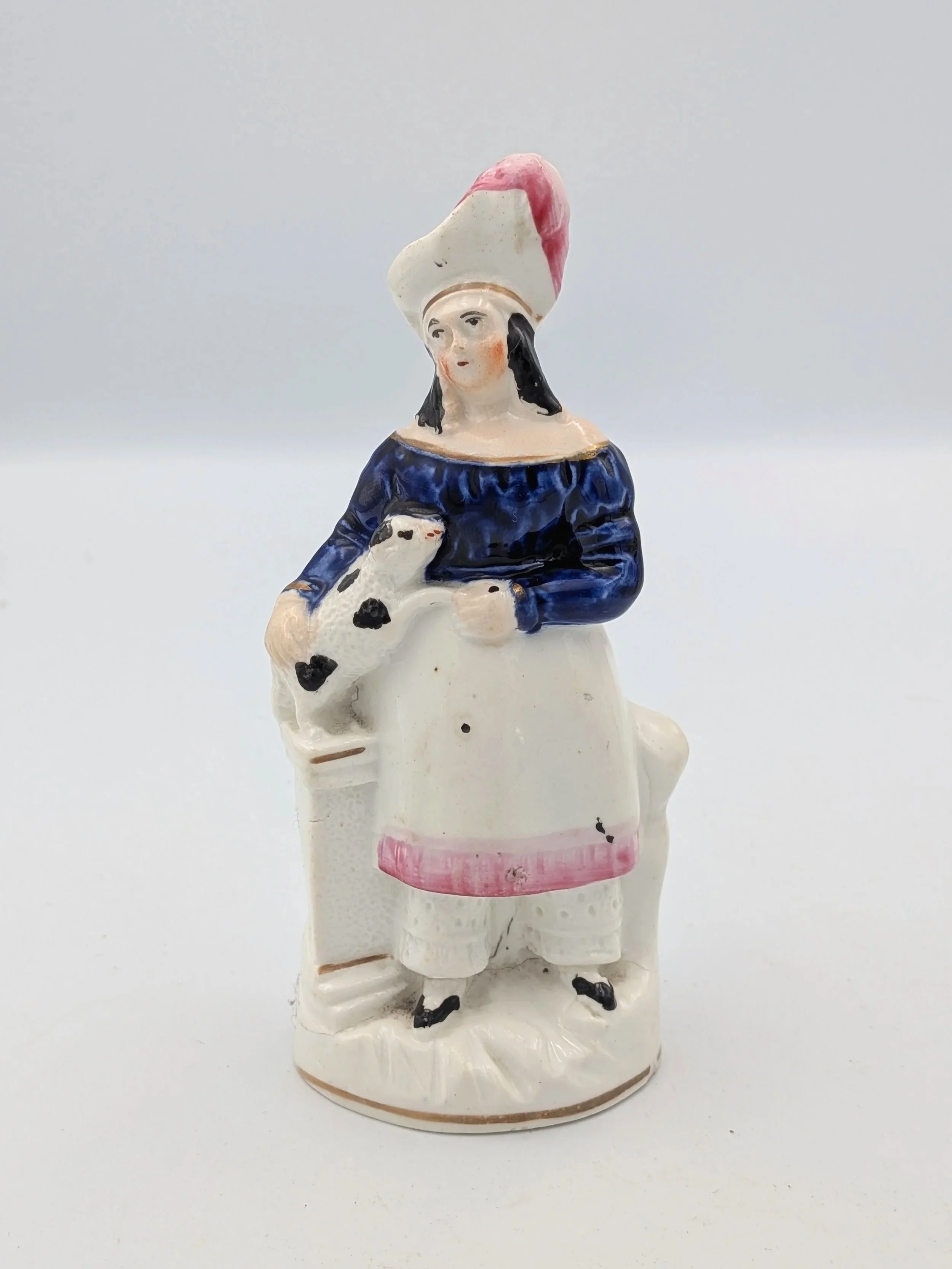
A charming figure depicting a girl standing by a column with an animal - probably a puppy.
This lovely little porcelaneous figure is very well modelled with pleasing depth and crispness, particularly to the column, base, and the girl’s bloomers.
The figure presents beautifully but is in repaired condition, with a clean break across the base (running along the line of the upright portion) having been discreetly - but not invisibly - repaired. Fortunately this is not particularly noticeable from the front.
Reference: Possibly unrecorded
Height: 5.5”
Date: c. 1840
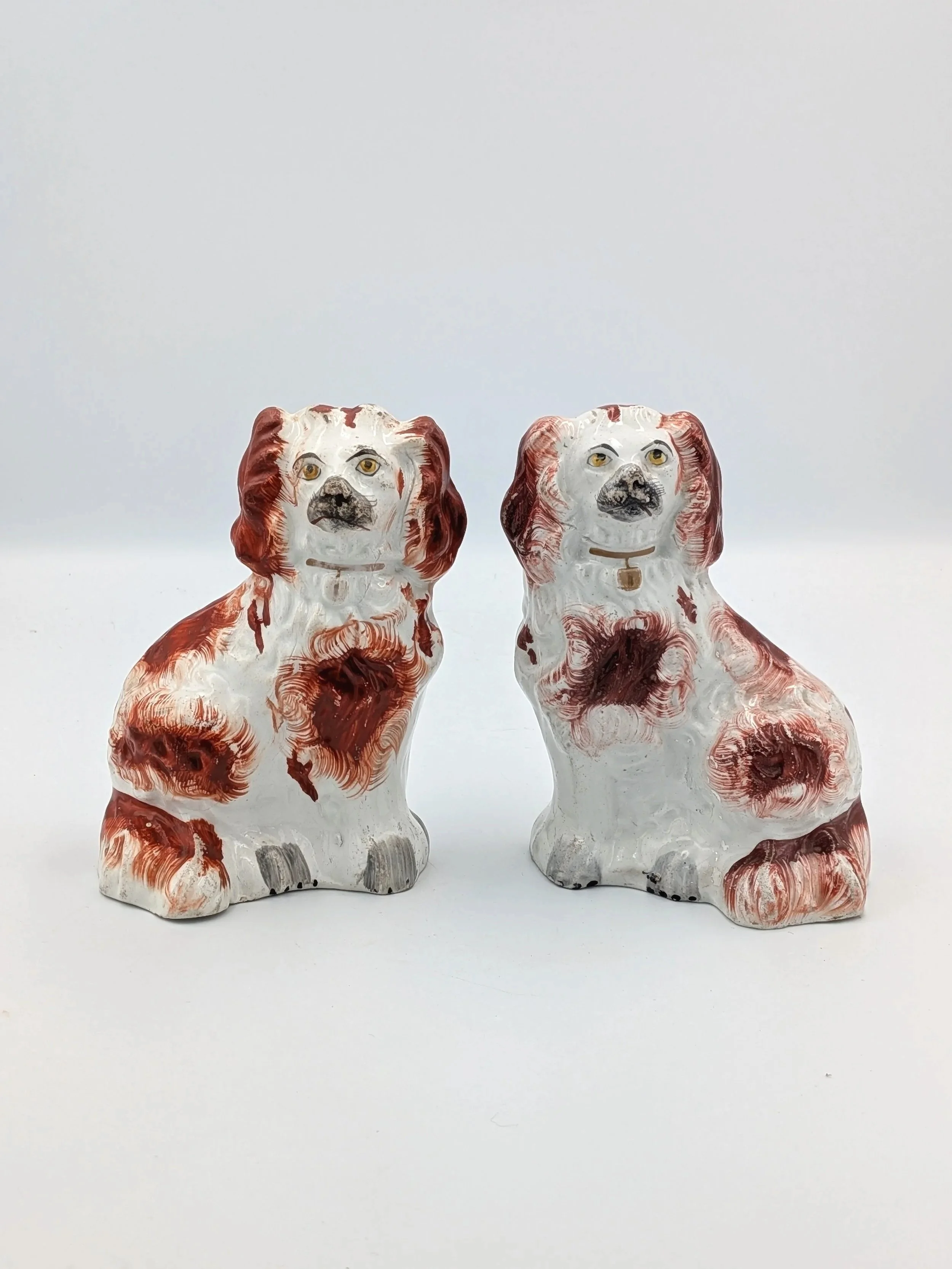
A matched pair of small russet and white spaniels.
These chunky dogs are made from a single press-mould with combined legs and tails. They wear gilded collars and locks and have yellow eyes. They are fairly well matched although their shades of russet are slightly different, as are the size of their spots.
The left hand figure has several shallow scuffs down to the clay body to the head and earns - some of these have been overpainted in russet to conceal them but a few others on the top of the head have been left. The right hand figure is in better condition with some scuffs around the rim of the base and some flaking to the russet.
Reference: Similar form to A. & N. Harding, Victorian Staffordshire Dogs, p. 25, figs 2460 and 2461
Height: 5”
Date: c. 1850s
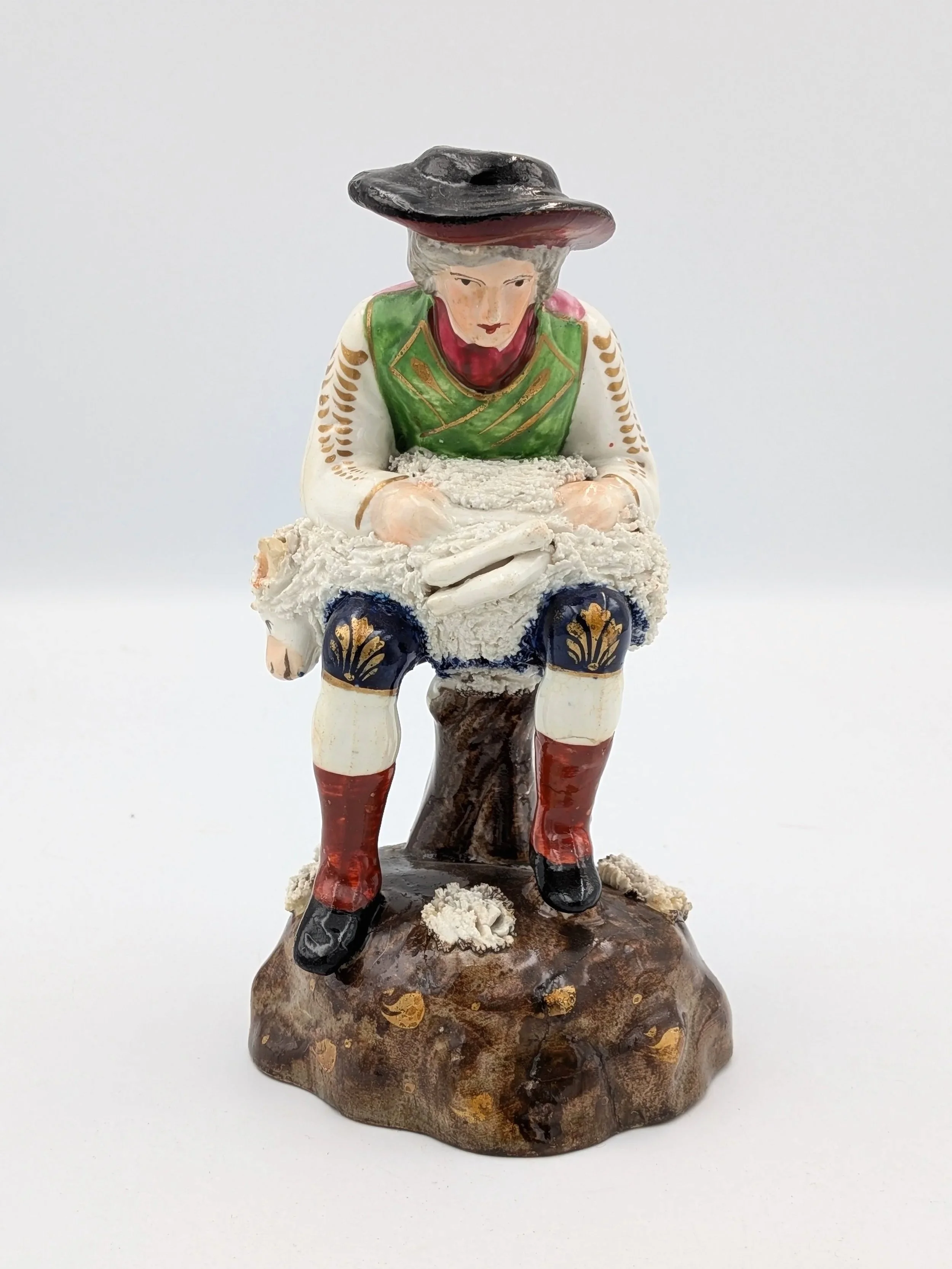
A fabulous and colourful porcelain figure depicting a seated sheep shearer, attributed to the Dudson Factory.
This wonderful figure is beautifully decorated and coloured with rich tones and careful enamelling.
It is offered in fairly good restored condition. The sheep’s ears; shearer’s left leg; shearer’s hat; and base have all been damaged and restored or repaired with a fair degree of proficiency, though not the extent they could be called ‘invisible’. In the case of the base, the cracks are visible as the restorer has not concealed them except on the underside, presumably for reinforcement. This means that the figure displays well but its troubled history is apparent at close inspection. Nevertheless, it is a delightful figure.
Reference: Possibly unrecorded
Height: 6.5”
Date: c. 1830s
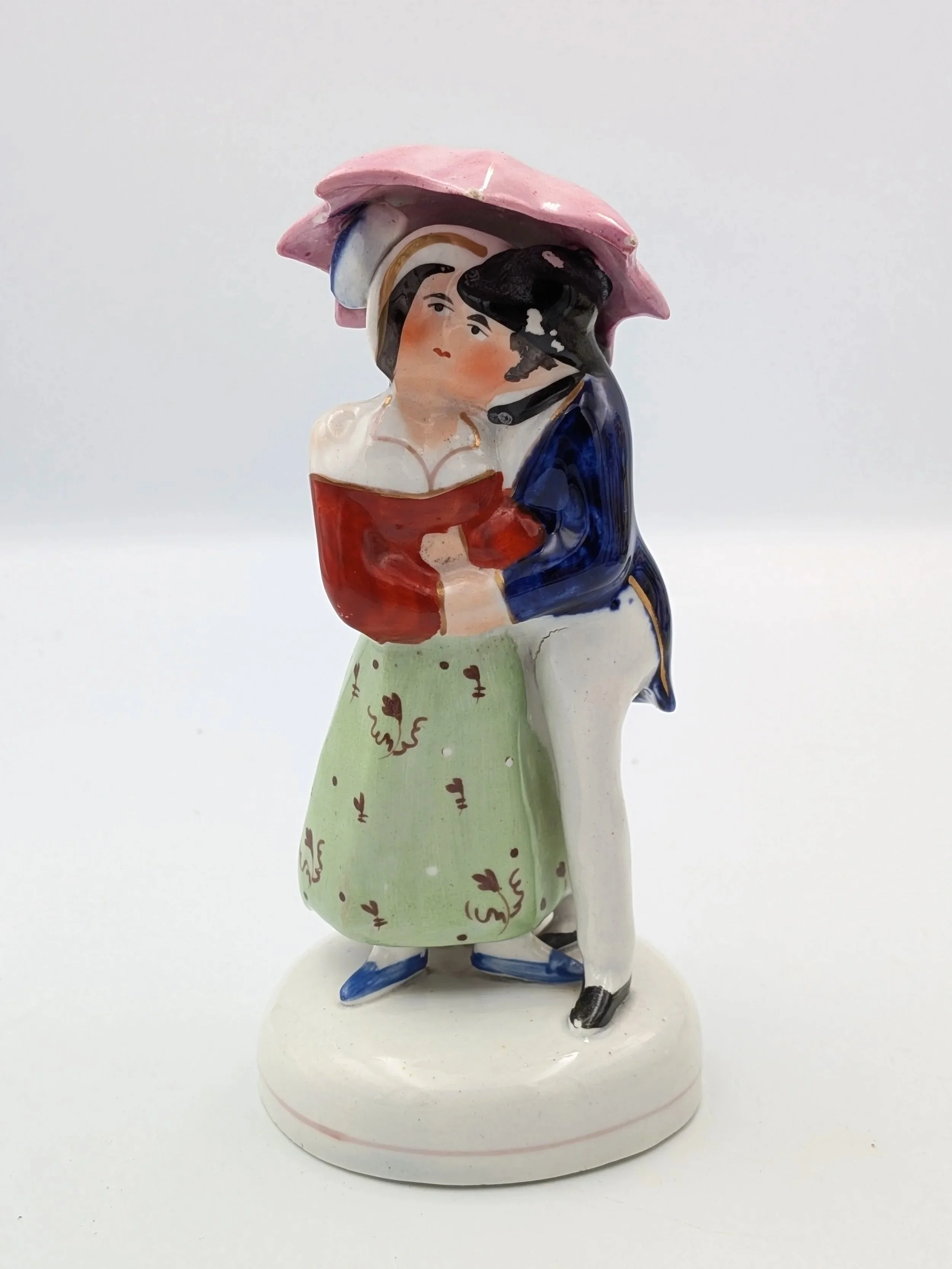
A charming figure depicting a gentleman and lady standing together under an umbrella.
This is one of a number of figures depicting couples under umbrellas. Some seem to be theatrical in nature and others have been identified as Queen Victoria and Prince Albert, though the characters in this figure bear no resemblance to the royal couple.
This charming figure is especially naïve and unusual due to the fact that the nature of the model means the man and woman appear to share a face. It benefits from individually modelled legs.
The figure is in very good condition. There are some little nicks to two points of the umbrella and some flaking to the man’s hair. There is a firing flaw at the top of the man’s left leg. The figure has been professionally and effectively invisibly reattached to the base.
Reference: Possibly unrecorded
Height: 6”
Date: c. 1850
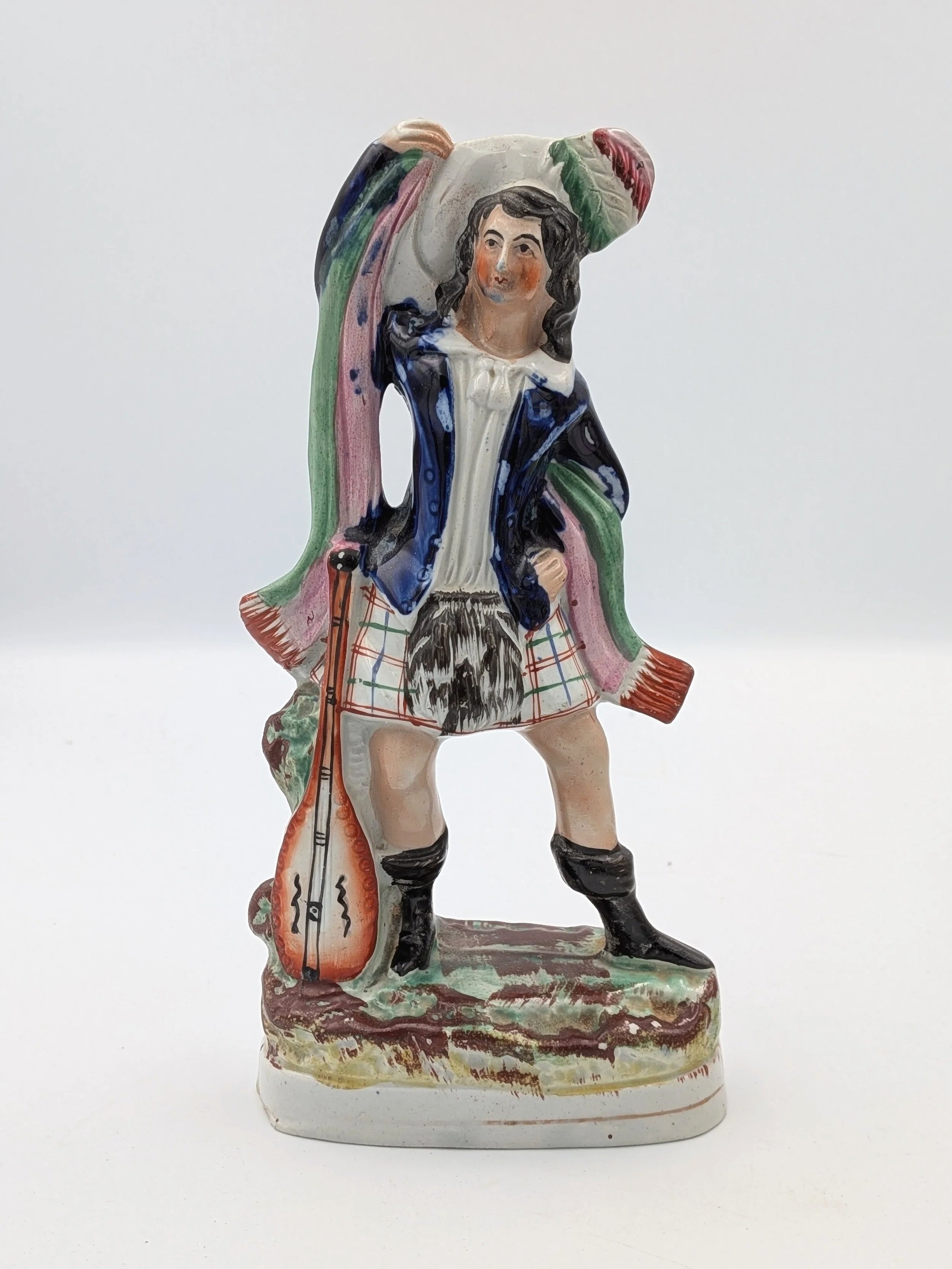
A handsome and well modelled figure depicting a male highland musician standing by a long stringed instrument.
This figure is crisp and nicely decorated. it makes for a striking display.
The figure is offered in reasonably good condition and it displays excellently. There is a small chip to the edge of the end of the musician’s scarf on the (viewer’s) left. The hat’s plume has been professionally restored. There is some nibbling to one side of the base and some sparse flaking (and some retouching to the black).
Reference: Possibly unrecorded
Height: 7.75”
Date: c. 1860
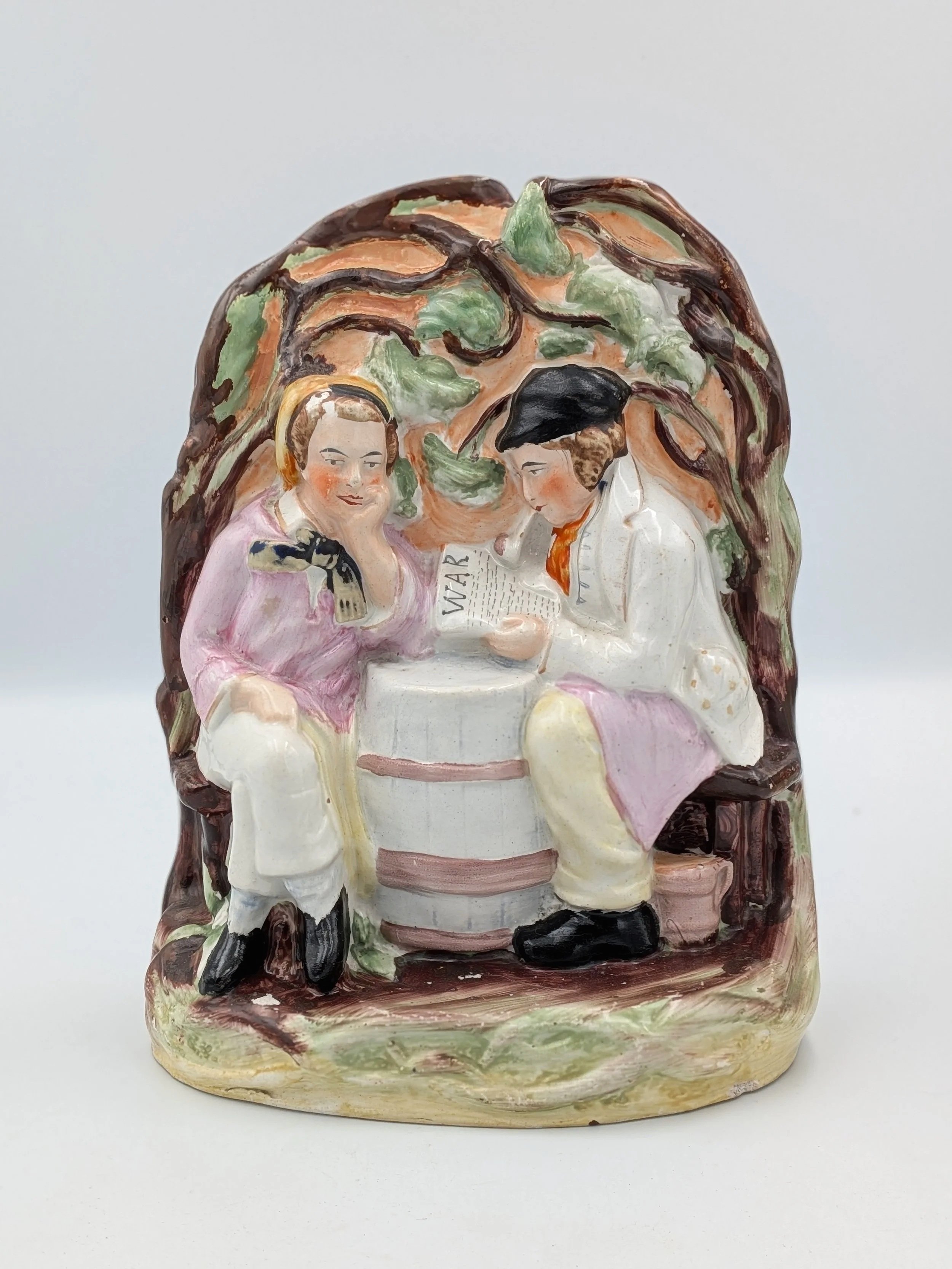
A good looking heavy earthenware figure depicting two men sitting at a barrel reading a newspaper announcing the outbreak of war.
The first versions of this figure were produced in 1854 at the outbreak of the Crimean War. The figure was reproduced throughout the 19tyh century whenever war was declared. This iteration seems to be an earlier version.
The figure presents well. There is some very discreet restoration to the moulded branch features, and the black enamels have been repainted. There is a firing flaw to the back and some nibbles around the base.
Reference: A. & N. Harding, Victorian Staffordshire Figures 1835 - 1875L: Book Three, p. 74, fig. A 927 (original Crimean version)
Height: 8.5”
Date: c. 1854 or later
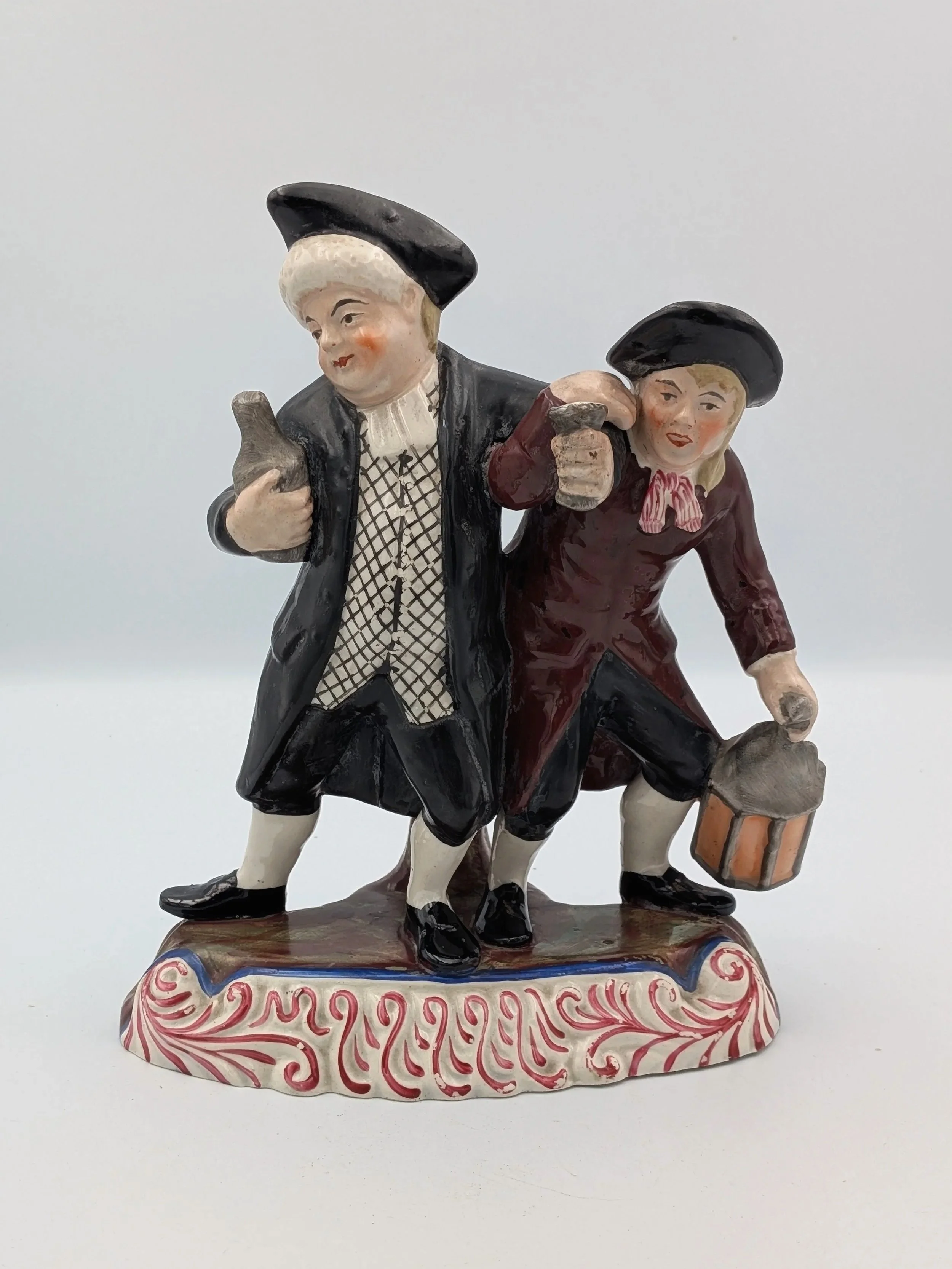
A late 19th or first-half 20th century heavy earthenware figure depicting two drunkards in 18th century dress.
This figure was made by the William Kent Factory. It is a copy of an early figure, made by a number of potters including Enoch Wood, which is sometimes referred to as ‘The Vicar and Moses’, ‘The Parson and The Clerk’, or ‘The Drunken Night Watchman’ (and some other variations).
Kent reproduced this figure in Staffordshire until the end of figural production and called his figure ‘Inebriates’ in his catalogue.
This figure is very commonly found being mis-sold as ‘early’. It is one of the most commonly mis-sold Staffordshire figures. It is, nevertheless, an appealing item and comparatively well made by the standard of Kent’s copies of pre-Victorian figures
This figure is in excellent condition with no damage or repair.
Reference: Kent Factory Catalogue 1955, fig. no. 277
Height: 8.75”
Date: Late period
Provenance: Ex Collection of Sir Alfred Owen, New Hall
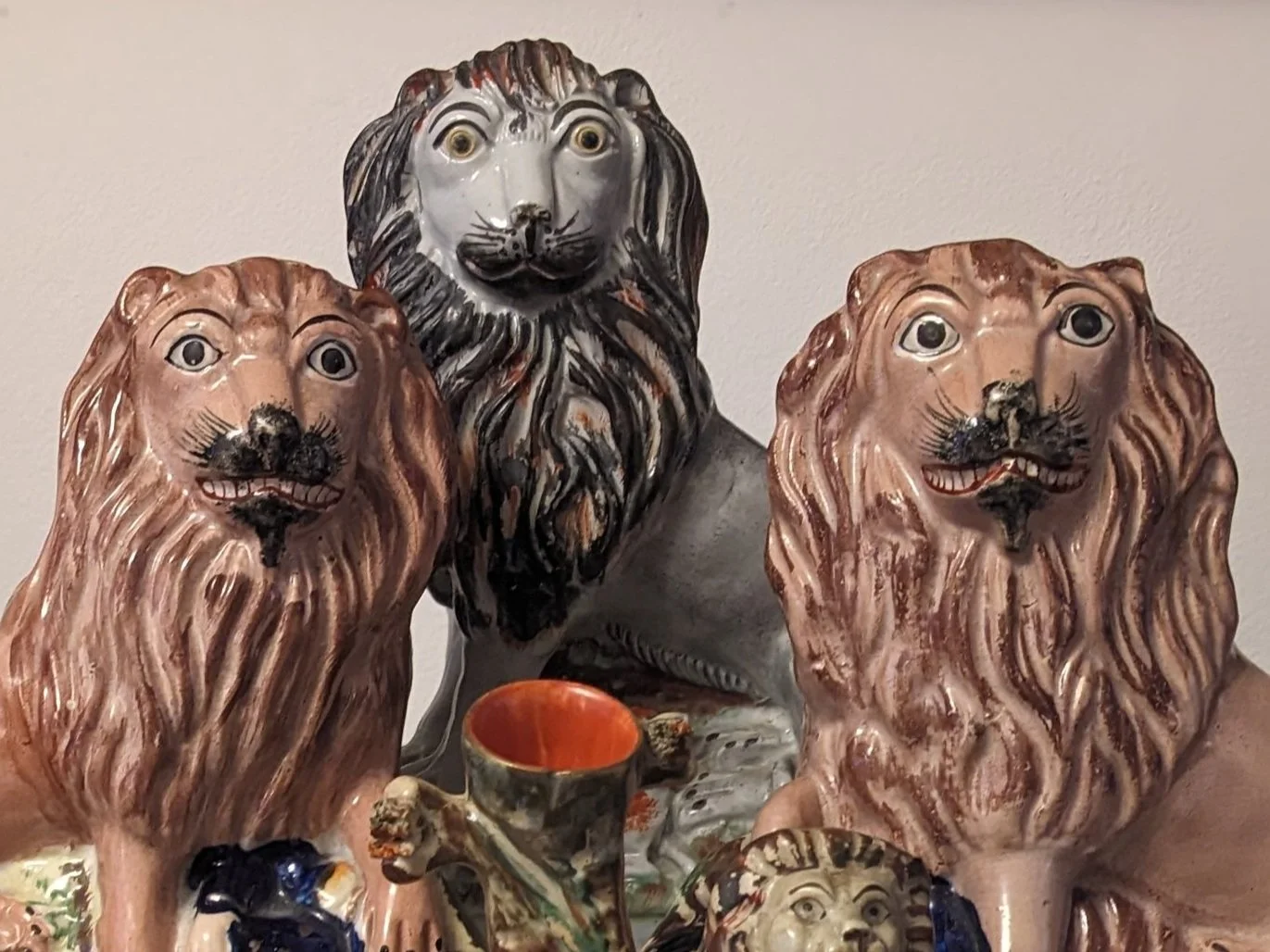
A very appealing pair of horse figures.
These simple models are more commonly found masquerading as zebras but were originally intended to be horses. They are simply modelled but striking and attractive.
They are in good condition with some light flaking and a number of firing flaws as shown in the photos, but no damage.
Reference: A. & N. Harding, Victorian Staffordshire Figures 1835 - 1875: Book Three, p. 271, figs a2997 and a2998
Height: 8.75”
Date: c. 1870